Clinical Movement & Longevity Specialist Pathway
A professional training pathway for movement educators who want to go beyond teaching exercises — and learn the reasoning between assessment and intervention.
One pathway. The reasoning most practitioners never learn.
Most courses teach exercises. Some teach assessment. Nobody teaches what comes between.
You have done the training. You know the exercises. You can read a posture chart. But when a client does not respond the way the manual said they would — when the standard programme fails and the client is still in front of you — most practitioners reach the same wall.
The gap is not in your exercise library. It is not in your assessment technique. It is in the reasoning between them. Knowing what you see and knowing what to do about it are two completely different skills. The second one is almost never taught.
Exercises, repertoire, anatomy, assessment protocols.
The reasoning between what you find and what you do about it.
Assessment, decision logic, tool selection, and the clinical judgment to choose the right intervention for this body, right now.
The Clinical Movement and Longevity Specialist Pathway is built around that gap. Every level, every module, every supervised hour exists to close it — until a graduate can put any body in front of them, read what it needs, reason through the options, and choose the right path forward.
"The goal is not a practitioner who knows more exercises. It is a practitioner who knows why they are choosing this one, for this body, at this moment."
Dr. Abhishek AgrawalHow the pathway is structured
Every level builds on the one before. You do not advance to the next until you can demonstrate the capability of the current one.
Read the Body
What is this body doing, and why?
Assess any body — static, dynamic, structural, functional — and describe findings in clinical language.
Decide the Path
What does this body actually need?
A reasoning framework to move from findings to intervention, without following a routine.
Apply the Tool
Which instrument does this body need now?
Select from any method — yoga, Pilates, corrective exercise, myofascial work — because the body demanded it.
Prove It on Real Bodies
Can you do this under observation?
A completed clinical practicum. Graduation is awarded on demonstrated capability, not seat time.
The tools — yoga, Pilates, Reformer, corrective exercise — are inside the curriculum. They are instruments the practitioner reaches for. They are not the destination.
The practitioner who can work with a 60-year-old as confidently as a 30-year-old.
Most movement training is built around younger, healthier, more predictable bodies — the average client in the average class. It is not designed for the client in the second half of life: the body that moves differently, recovers more slowly, carries decades of compensatory patterns, and has different goals entirely.
Longevity, in Abbysan's context, is not about slow classes or modified exercises. It is about functional capacity across the lifespan — maintaining movement quality, joint health, posture, breathing efficiency, balance, and strength as the body changes. Not by fighting the changes, but by understanding them well enough to work with them.
Functional ageing
How movement capacity, tissue quality, and recovery change across decades — and how to programme for each stage.
Joint function and longevity
Protecting joint health through load management, alignment correction, and appropriate progressive training rather than avoidance.
Posture across the lifespan
Recognising how postural patterns accumulate over time, and interrupting compensation before it becomes permanent.
Breathing efficiency
Restoring optimal breathing mechanics as a foundation for movement capacity, nervous system regulation, and endurance.
Balance and proprioception
Training the systems that deteriorate fastest with age — and that carry the highest consequence when they fail.
Strength with intelligence
Building strength in patterns the body will actually use — functional load capacity across real movement demands.
A Clinical Movement and Longevity Specialist is not a specialist in ageing. They are a specialist in bodies — and that means every body, at every stage. The practitioner who can read a 68-year-old's movement history and build a programme that restores function without accelerating wear is a practitioner who will never run out of people who need exactly what they do.
Four certifications. One progression.
Each has a defined entry point, a defined exit standard, and a title that means something specific. You enter where your background places you. You exit when you can demonstrate the capability.
Movement Teaching Foundation
Open entry · No prerequisitesThe foundation for anyone starting from the beginning — a sound anatomical and assessment base before any clinical work.
Complete beginners, fitness professionals, and group exercise instructors with no clinical foundation.
Practical anatomy and biomechanics, kinetic chains, an introduction to postural and movement assessment, foundational programming, and teaching methodology.
Teach structured movement sessions confidently, with a sound anatomical foundation and basic postural observation.
Certification 2 — Posture Pilates Instructor.
Posture Pilates Instructor
AAA accreditedThe full Pilates Instructor Course — Mat, Reformer, and Tower — built on a structured posture and movement assessment protocol. This is the posture assessment and reasoning foundation of the pathway, and includes Reformer Pilates taught clinically.
Certification 1, or demonstrated equivalent (prior anatomy training, teaching experience, documented hours). Portfolio review required.
Yoga teachers, fitness professionals, and existing Pilates teachers who trained elsewhere and want clinical depth.
Full static and dynamic posture assessment, the Pilates Instructor Course curriculum (Mat, Reformer, Tower), movement impairment classification, corrective programming, and observed teaching. 200 hours across both levels.
Assess posture and movement dysfunction, design and deliver clinical Pilates on Mat, Reformer, and Tower, and document client progress with clinical precision.
Clinical Movement Specialist
Assessment submission requiredThe full clinical reasoning layer — taught explicitly. Where the RALLM decision framework and the Case Library turn assessment into intervention.
Certification 2, or interview plus portfolio demonstrating equivalent clinical movement competency. Entry is not automatic.
Posture Pilates graduates, physiotherapists, and rehab professionals who regularly meet complex clients and need a decision framework.
The RALLM decision framework, the Movement Decision System, posture classification and Sahrmann Movement Impairment integration, the Case Library, cross-modality tool selection, and complex client programming.
Assess, reason, and select the right intervention from any method — and work confidently with complex clients who have not responded to standard approaches.
Abbysan Method Mentorship
By invitation onlyThe most advanced designation in the pathway. Not a course — a supervised clinical mentorship, reserved for practitioners ready to carry the Abbysan name.
Completion of Certifications 1–3, a case review by Dr. Abhishek, and a personal interview. Each candidate is approved individually.
Clinical Movement Specialist graduates ready to work at the highest level of the Abbysan methodology.
Advanced clinical case supervision, direct mentorship on complex presentations, and integration of all pathway learning into a personal practice model.
The Abbysan Method Mentorship designation — for practitioners with the reasoning, judgment, and clinical maturity to carry the approach.
An internationally recognised accreditation — your qualification is valid well beyond Thailand.
You do not learn clinical reasoning by watching success. You learn it by watching decisions.
Standard courses show you outcomes. A client had back pain. These exercises helped. The pain reduced. The case is closed.
That is not how clinical reasoning works. The outcome is the last five percent. The other ninety-five is the decision process that produced it — what was observed, what was suspected, what was tested and ruled out, what was selected, and why that choice over the alternatives.
- What was observedThe full assessment picture.
- What was initially consideredThe differential reasoning.
- What was ruled out and whyThe elimination logic.
- What was selectedThe intervention decision.
- Why that choice over the alternativesThe clinical justification.
- What happenedThe outcome, and what it confirmed or revised.
The goal is not to copy outcomes. It is to internalise the reasoning — so that when a body the textbook did not cover walks in, the graduate has a decision process to reach for, not just an exercise library.
- Observed
- Recurrent right-side low back tension. Anterior pelvic tilt. Reduced hip extension on the right. Breath held high in the chest.
- Considered
- Hip flexor dominance · weak posterior chain · breathing-driven pressure fault.
- Ruled out
- Pure flexibility deficit — passive range was available, but not controlled.
- Selected
- Breath-led pressure reset before loading. Posterior chain re-education, not stretching.
- Why
- The body had range; it lacked control and a stable pressure system. Stretching a guarding pattern would have reinforced it.
- Outcome
- Tension reduced across four sessions; confirmed the pressure-system hypothesis.
Illustrative example · not real patient data
The Pilates instructor training is now the route into the pathway.
For years this was a standalone Clinical Pilates Instructor Course in Phuket — Posture Pilates and Clinical Pilates, AAA-accredited, one hundred hours each across Mat, Reformer, and Tower. It still exists in full. It now lives inside this pathway as the Pilates route in, so a Pilates instructor course becomes the start of becoming a movement and longevity specialist, not the finish line.
The full Pilates exercise toolkit plus posture and movement assessment. One hundred hours, Mat and Reformer, AAA-accredited. Open entry — no prerequisites.
Clinical Pilates rehabilitation for complex and specialised populations. One hundred hours, Mat, Reformer, and Tower, AAA-accredited. Level 1 required.
The people who have walked it.
Two of our graduates, in their own words.
Where does your background place you?
You do not have to start at the beginning if you can demonstrate you are already past it.
Not sure where you belong? Send a brief summary of your training and clinical experience to info@abbysan.com. Dr. Abhishek reviews every application personally and will tell you exactly where you should enter, and why. Already practising and looking for ongoing, case-by-case guidance rather than the full pathway? That is what the one-to-one clinical mentorship is for.
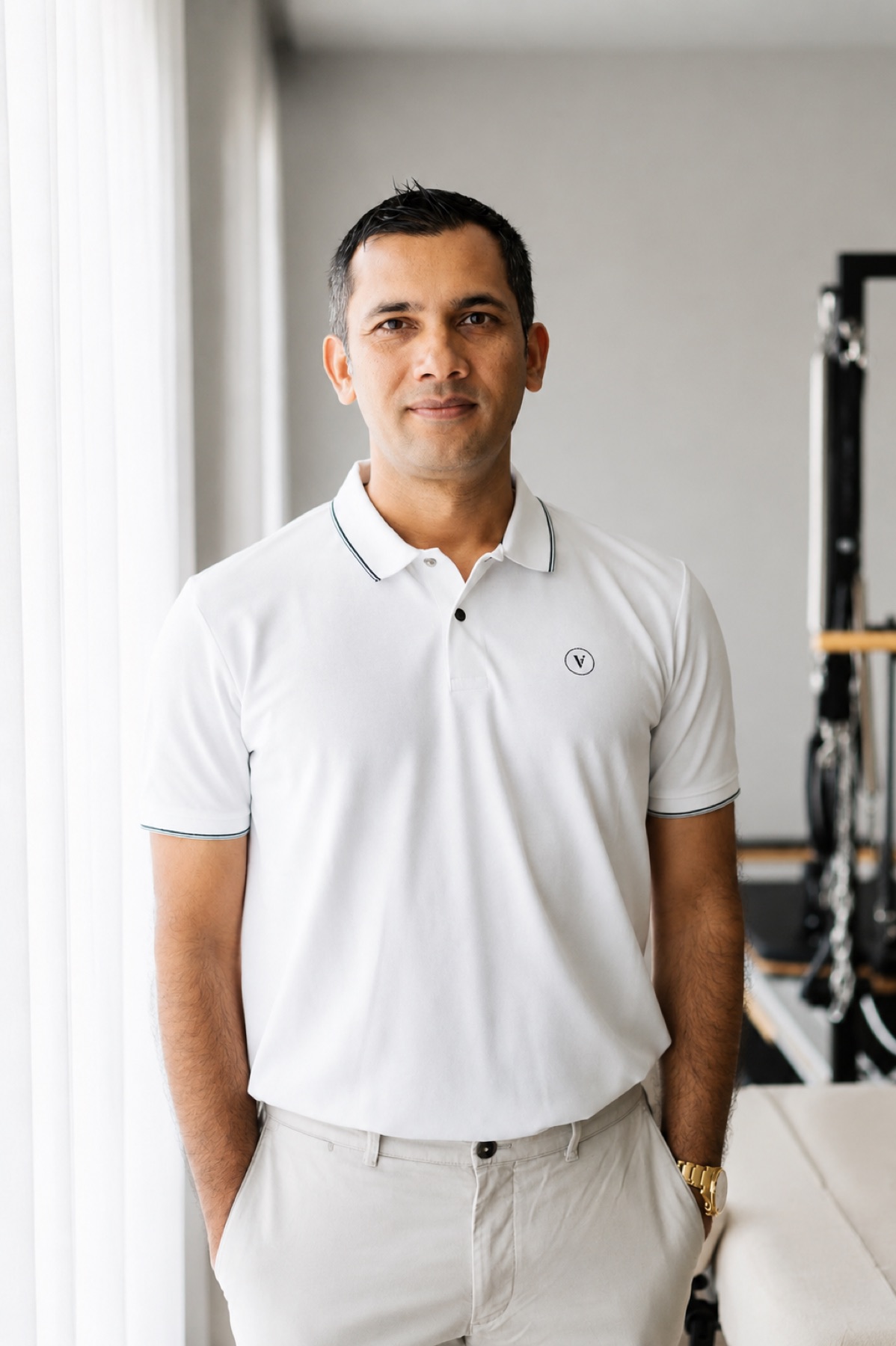
Built by someone who has spent twenty years finding what everyone else missed.
Dr. Abhishek Agrawal holds a Bachelor of Naturopathy and Yogic Science — a five-year traditional medicine degree — alongside postgraduate training in Wellness Rx, ERYT-500 Yoga Therapy, STOTT Pilates, PCES, and Precision Nutrition. He has been based in Phuket since 2006, working clinically with complex movement dysfunction cases from across the world.
This pathway is the formal, structured expression of what he has practised and refined across nearly two decades. Every module, every decision framework, and every case in the library comes from real clinical work — not from a curriculum committee or an accreditation template.
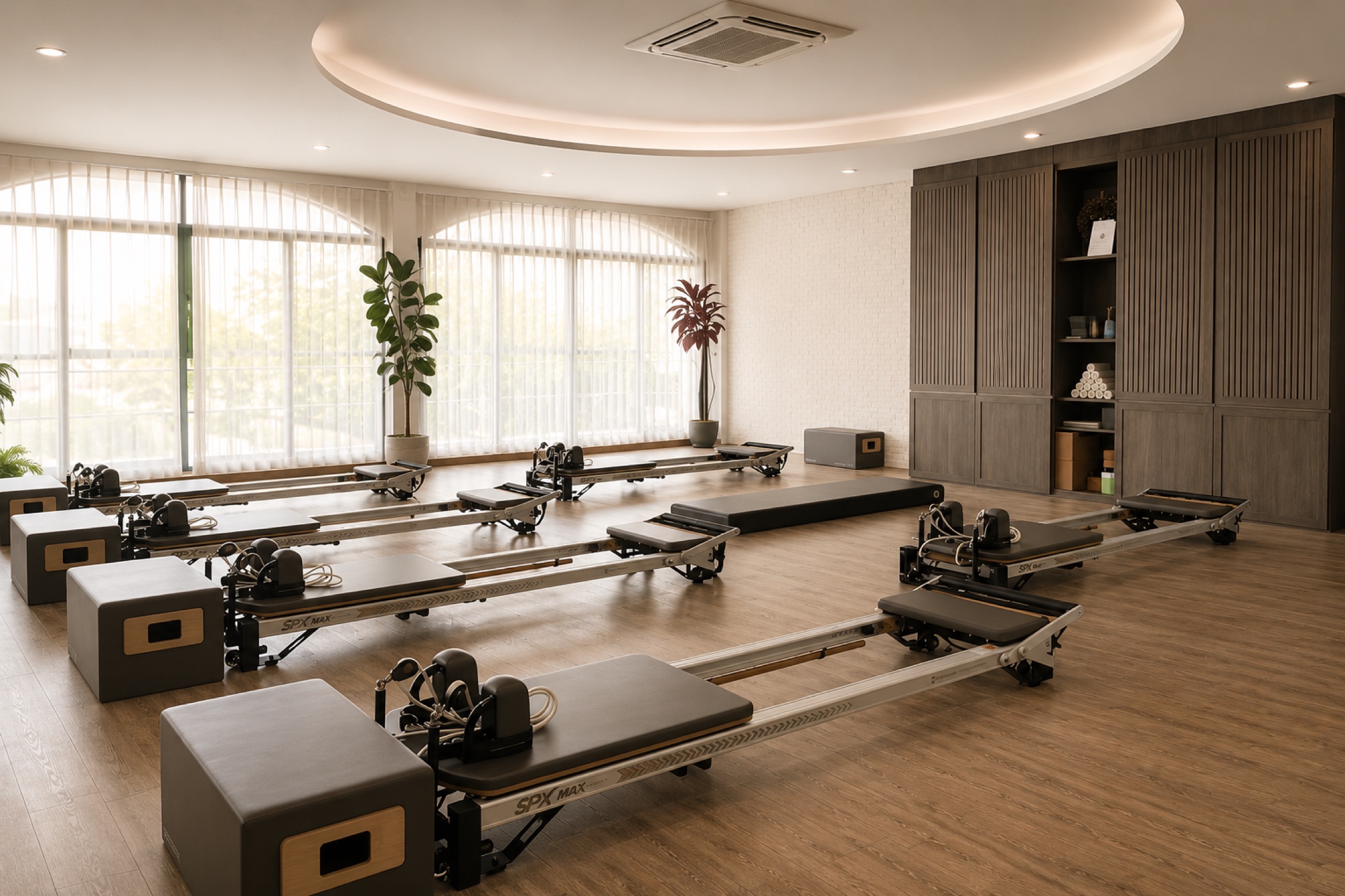
One pathway. The reasoning most practitioners never learn.
Intake is small by design — a maximum of three to four students per cohort. If you are ready to start, or want to understand which level is right for you, reach out directly.
Or email info@abbysan.com · Phuket, Thailand
