Many people associate low energy only with poor sleep, stress, diet, or lack of motivation.
While these factors are important, posture also plays a major role in how efficiently the body produces, distributes, and uses energy throughout the day.
Most people notice this relationship naturally without consciously thinking about it.
When someone feels energetic, confident, or motivated, posture often changes automatically:
- the spine becomes more upright
- breathing becomes deeper
- movement becomes more expressive
- the body appears more alert
The opposite is also true.
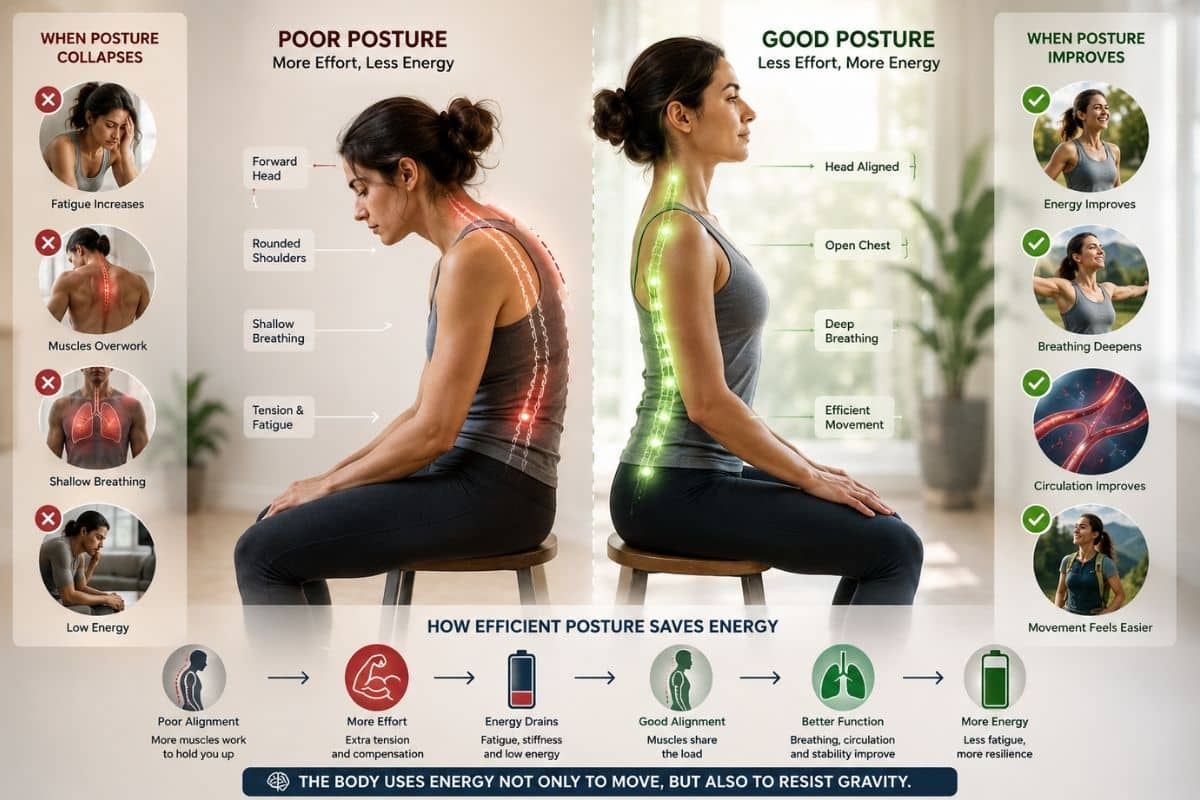
During fatigue, emotional stress, disappointment, or low-energy states, posture often becomes more collapsed:
- the head moves forward
- the shoulders round
- breathing becomes shallower
- movement becomes slower and less efficient
This relationship works in both directions.
Energy influences posture, but posture also influences energy.
Understanding this connection helps explain why posture affects not only how the body looks, but also how it breathes, circulates, stabilises, and functions throughout daily life.
1. The Relationship Between Posture and Energy
The human body is constantly working against gravity.
Every second of the day, muscles, joints, breathing mechanisms, and the nervous system must coordinate together to keep the body upright and balanced.
This process requires energy.
When posture is organised efficiently:
- muscles share load more evenly
- breathing becomes easier
- movement becomes more coordinated
- less unnecessary tension develops
As a result, the body uses energy more efficiently.
However, when posture becomes poorly organised:
- muscles work harder to stabilise the body
- tension increases
- movement efficiency decreases
- fatigue develops more quickly
This is why prolonged slouching or poor posture often creates a sensation of heaviness, stiffness, or low energy.
The body begins spending more energy simply maintaining position against gravity.
For people experiencing recurring discomfort alongside poor posture, Pain Relief Therapy in Phuket can help assess how alignment, muscular tension, and movement compensation may be contributing to symptoms.
2. How Posture Affects Breathing and Circulation
Breathing and posture are closely connected.
A collapsed posture often reduces ribcage mobility and changes how the diaphragm functions during breathing.
This may lead to:
- shallower breathing
- increased neck and shoulder tension
- reduced spinal mobility
- reduced movement efficiency
When posture improves, many people naturally take a deeper breath without consciously trying.
This happens because the ribcage, diaphragm, and spine are able to move more freely.
Improved breathing mechanics help support:
- oxygen delivery
- circulation
- pressure regulation
- spinal stability
Research available through PubMed on Pilates, breathing exercises, posture, and lung function has examined how combined posture and breathing training may influence respiratory performance and postural stability.
Circulation is also influenced by movement and posture.
Muscles help move blood and fluids throughout the body. When posture becomes stagnant and movement decreases, circulation may become less efficient, particularly in areas under prolonged tension or compression.
This often contributes to:
- stiffness
- fatigue
- heaviness
- reduced recovery
The body functions best when breathing, posture, and circulation work together efficiently.
3. Gravity, Muscular Effort, and Fatigue
Gravity constantly pulls the body downward.
To remain upright, the body must continuously organise itself against this force.
When posture is efficient, the body distributes load more evenly through the muscular and skeletal systems.
When posture becomes inefficient:
- some muscles become overworked
- other muscles become weak or inhibited
- unnecessary muscular effort increases
Over time, this excessive effort contributes to fatigue.
For example:
- forward head posture increases the workload on the neck and upper back
- rounded shoulders increase tension through the chest and upper spine
- pelvic imbalance changes how force travels through the lower body
This means the body may use more energy simply trying to maintain posture and complete everyday activities.
The body spends energy not only to move, but also to resist gravity.
4. The Nervous System and Movement Efficiency
Posture also influences how the nervous system responds to the environment.
An upright and organised posture is often associated with:
- increased alertness
- better breathing regulation
- improved movement coordination
- more efficient muscle activation
A collapsed posture is commonly associated with:
- reduced alertness
- increased tension
- shallow breathing
- slower movement responses
This does not mean posture alone determines mood or emotional state.
However, posture strongly influences how efficiently the nervous system coordinates breathing, movement, and muscular activity throughout the day.
Research into forward head posture, sensorimotor function, and breathing patterns has also explored the relationship between thoracic posture, respiratory function, and movement control.
Movement efficiency also affects energy expenditure.
When the body moves efficiently:
- force transfers more effectively
- muscles activate proportionately
- joints tolerate load more comfortably
- less unnecessary effort is required
Efficient movement allows the body to conserve energy instead of wasting it through excessive compensation and tension.
5. Why Posture-Based Movement Improves Energy
Improving energy is not only about exercising harder.
It is about helping the body move and stabilise itself more efficiently.
Posture-based movement therapy focuses on improving:
- alignment
- breathing mechanics
- muscular balance
- circulation
- movement coordination
- load distribution
When these systems improve together, many people notice:
- reduced fatigue
- improved breathing
- less stiffness
- better movement efficiency
- improved recovery capacity
This does not replace the importance of:
- nutrition
- sleep
- hydration
- stress management
However, posture strongly influences how effectively the body uses and distributes energy throughout the system.
At Abbysan, posture is assessed not only for appearance, but for how the body organises itself under gravity during movement and daily activity.
Professionals who want to develop a deeper understanding of posture, breathing, coordination, and movement progression can also explore the Pilates Instructor Course.
The goal is not simply to “stand straighter.”
The goal is to help the body move, breathe, and function with less unnecessary effort.
Final Thoughts
Posture affects far more than appearance.
It influences breathing, circulation, muscular effort, nervous system regulation, and the way the body uses energy throughout the day.
When posture becomes poorly organised, the body often spends more energy compensating against gravity and stabilising inefficient movement patterns.
Over time, this may contribute to fatigue, stiffness, reduced movement efficiency, and low energy.
Improving posture is not about creating a rigid position.
It is about helping the body organise movement more efficiently so breathing, circulation, and muscular activity can function with less unnecessary effort.
In simple terms:
The body uses energy not only to move, but also to resist gravity.