Many people experiencing back pain focus only on the spine.
They stretch the lower back, strengthen the core, or seek treatment directly around the painful area. While this may provide temporary relief, the source of the problem is not always located where the pain is felt.
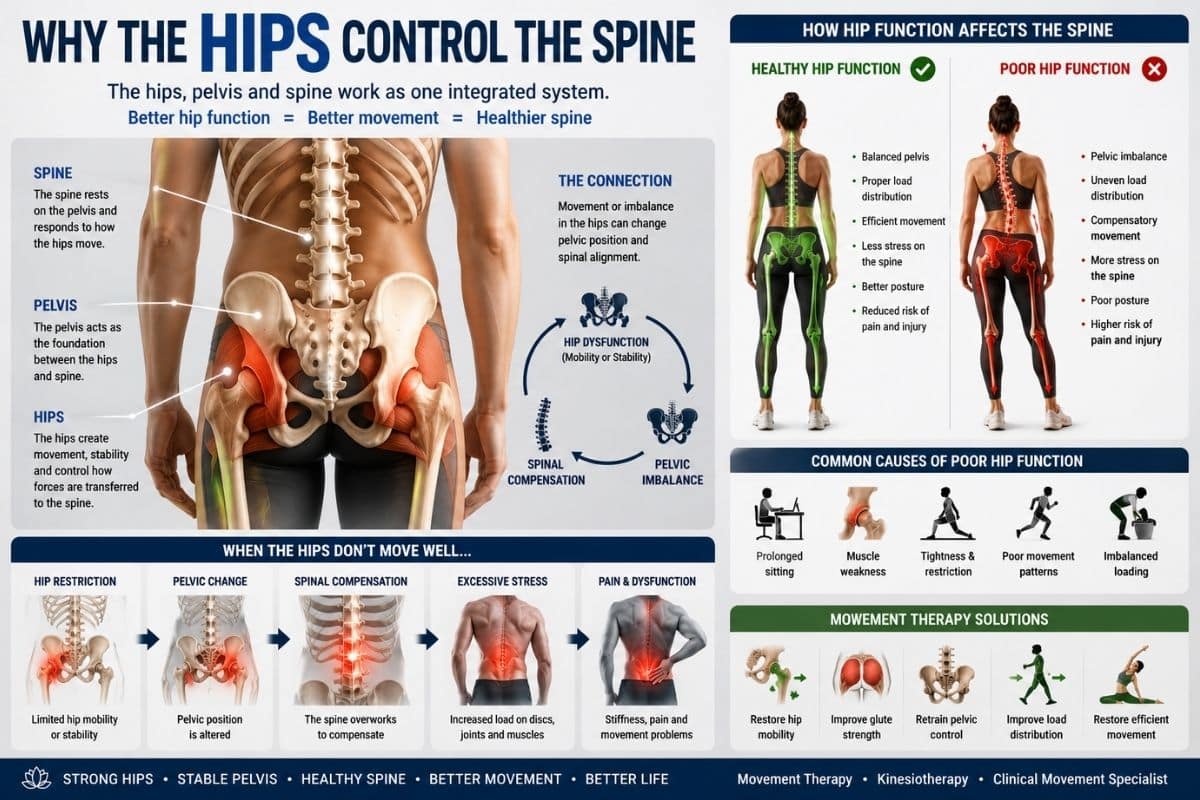
The hips, pelvis, and spine function as one connected movement system.
Because of this relationship, the way the hips move and stabilise the body has a direct influence on spinal alignment, load distribution, and movement efficiency.
Understanding this connection is essential for improving posture, reducing mechanical stress, and restoring efficient movement.
1. Understanding the Lumbopelvic-Hip Complex
The hips, pelvis, and spine work together as a functional unit known as the lumbopelvic-hip complex.
This system is responsible for:
- supporting the body against gravity
- transferring force during movement
- stabilising the spine
- producing efficient walking, running, and rotational movement
The hips form the primary support structures beneath the pelvis.
The pelvis then acts as the foundation for the spine.
Because these structures are mechanically connected, movement or imbalance in one area immediately affects the others.
For example:
- hip restriction may alter pelvic position
- pelvic imbalance may change spinal mechanics
- spinal compensation may affect gait and hip loading
The body does not move in isolated parts. Instead, it moves as an integrated system.
2. How the Hips Influence Spinal Alignment
The hips play a major role in controlling how the pelvis positions itself during movement.
Since the spine rests directly above the pelvis, even small changes at the hips can influence spinal alignment significantly.
A simple example is standing with one foot slightly in front of the other.
Notice how the pelvis and torso naturally rotate. This demonstrates how hip position immediately changes the organisation of the spine and upper body.
During walking, running, and sports, the hips continuously guide how forces move through the pelvis into the spine.
When the hips move efficiently:
- load is distributed more evenly
- the spine moves with better support
- movement becomes smoother and more stable
However, when hip mobility or stability becomes compromised, the spine often compensates.
Over time, this compensation may contribute to:
- excessive lower-back movement
- asymmetrical loading
- muscular overuse
- joint irritation
- movement inefficiency
In many cases, spinal discomfort is not only a spinal issue. It may also reflect how forces are being transferred from the hips into the spine.
3. Why Rigid Hips Overload the Lower Back
Healthy hips are designed to move efficiently in multiple directions, including:
- flexion and extension
- rotation
- abduction and adduction
When hip mobility becomes restricted, the body still needs to complete movement tasks such as walking, bending, lifting, or running.
As a result, nearby structures often compensate.
The lower back is one of the most common areas forced to absorb this additional movement demand.
For example:
- limited hip extension may increase lumbar extension
- reduced hip rotation may increase spinal rotation
- poor hip mobility during lifting may overload the lower back
A systematic review published through PubMed on hip biomechanics in people with low-back pain reported differences in hip range of motion, muscle strength, muscle activation, and functional movement compared with people without low-back pain.
Over time, repeated compensation can place excessive stress on:
- spinal joints
- discs
- ligaments
- surrounding muscles and fascia
This may contribute to stiffness, irritation, muscular guarding, and gradual changes in movement tolerance.
Rigid hips do not only affect flexibility. They also change how forces travel through the entire body.
4. The Role of Muscles and Fascia
The relationship between the hips and spine is not only structural.
It is also muscular and fascial.
Many muscles and connective tissues link the legs, pelvis, and spine, including:
- gluteal muscles
- hip flexors
- hamstrings
- deep spinal stabilisers
- abdominal muscles
- thoracolumbar fascia
These structures help transfer force between the lower body and the spine during movement.
For example, when walking or running, force generated by the legs travels through the hips and pelvis before reaching the spine and upper body.
If these muscular and fascial systems are not functioning efficiently:
- force transfer becomes less organised
- joints absorb stress unevenly
- compensatory movement patterns develop
This is why weakness, tightness, or imbalance around the hips can influence spinal mechanics even when the spine itself appears structurally normal.
The body functions as one interconnected kinetic chain.
5. Why Hip Assessment Matters in Movement Therapy
Many people focus directly on the site of pain without understanding the wider movement system contributing to it.
However, long-term improvement often requires assessing how the hips, pelvis, and spine work together.
Movement assessment helps identify:
- asymmetrical loading patterns
- hip mobility restrictions
- pelvic instability
- movement compensations
- inefficient force transfer
Once these factors are understood, movement therapy and kinesiotherapy can be used more effectively.
This may include:
- restoring hip mobility
- improving gluteal strength
- retraining pelvic control
- improving load distribution
- restoring coordinated movement patterns
The goal is not simply to reduce pain temporarily.
Instead, the goal is to improve how the body organises movement under load.
A personalised Foundation Session can help assess hip mobility, pelvic control, spinal compensation, and load distribution before deciding how movement should progress.
At Abbysan, this is why assessment comes before progression.
Understanding how the hips influence the spine allows movement to become more balanced, efficient, and sustainable over time.
Final Thoughts
The spine does not function independently.
It responds continuously to the quality of movement occurring beneath it.
The hips influence pelvic position, force transfer, and movement mechanics throughout the body. When hip mobility or stability changes, the spine often compensates.
This is why many spinal problems are not purely spinal problems.
They may be movement-organisation problems involving the entire lumbopelvic-hip complex.
Improving spinal health often begins not only with treating the back but also with understanding how the hips, pelvis, and spine work together as one integrated system.