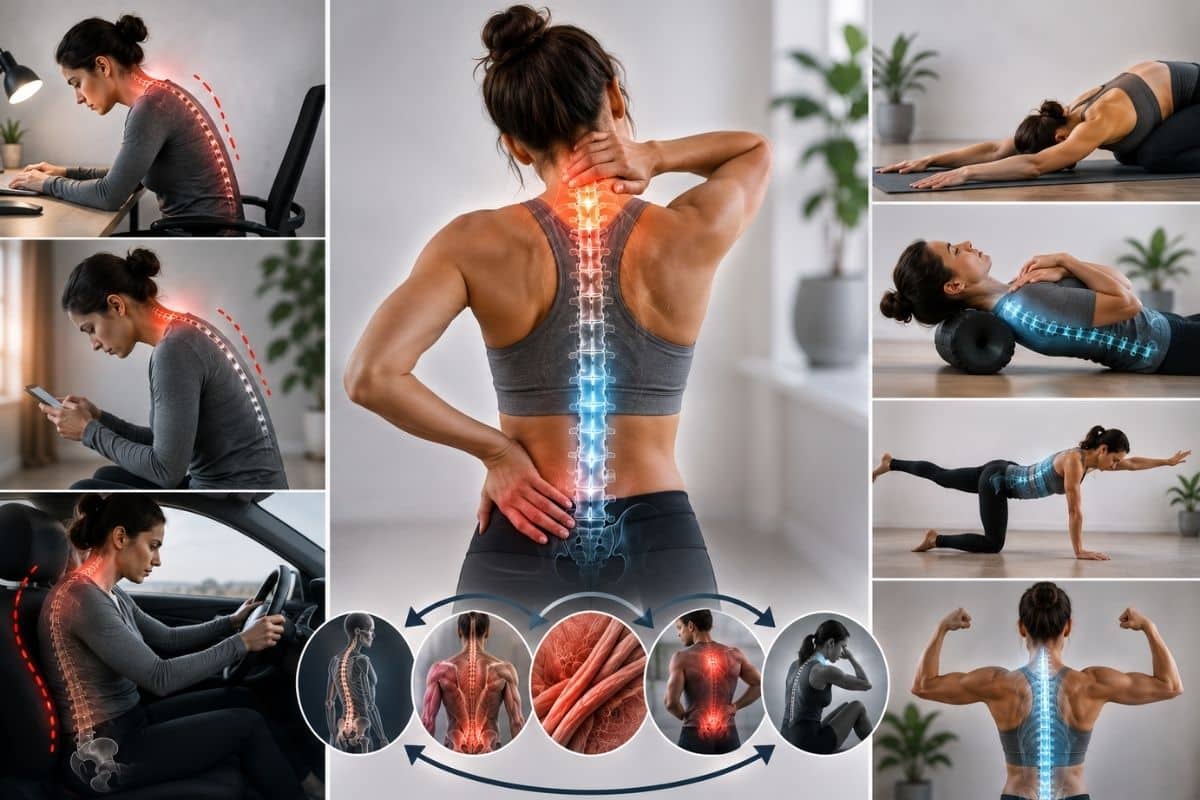
Many people experience temporary relief from stiffness after stretching, massage, heat therapy, or exercise, only to find that the stiffness gradually returns again.
This cycle is extremely common.
People often assume they simply need to stretch more, exercise harder, or become more flexible. However, stiffness is usually more complex than a simple flexibility problem.
In many cases, stiffness is the body’s way of responding to inefficient movement, poor load distribution, postural changes, and protective tension.
Understanding why stiffness returns is important because long-term improvement often requires restoring movement quality rather than only reducing symptoms temporarily.
1. Stiffness Is More Than a Flexibility Problem
Stiffness is often misunderstood as shortened muscles that simply need stretching.
While reduced flexibility can contribute to stiffness, many other factors also influence how stiff the body feels, including:
- posture
- breathing mechanics
- circulation
- muscular imbalance
- joint degeneration
- movement efficiency
- stress and fatigue
The body constantly adapts to the demands placed upon it.
When movement becomes less efficient, muscles and connective tissues often increase tension to improve stability and protection around joints.
This protective tension can create the sensation of stiffness even when muscles are not truly “short.”
In many cases, the body becomes stiff because it no longer feels stable or organised during movement.
2. How Posture and Gravity Influence Stiffness
The human body is constantly working against gravity.
Throughout life, posture gradually changes based on:
- movement habits
- muscle strength
- breathing patterns
- daily activity levels
- repetitive positioning
Over time, poor posture and prolonged sitting can alter how the body distributes load.
For example:
- forward head posture increases tension through the neck and upper back
- rounded shoulders restrict ribcage movement
- pelvic imbalance changes spinal mechanics
- reduced hip mobility increases stress on the lower back
As posture becomes less organised, muscles often work harder to stabilise the body against gravity.
This increased effort creates fatigue, tension, and reduced movement efficiency.
Gravity itself is not the problem. Instead, the issue is the body’s decreasing ability to organise itself efficiently against gravity.
3. Muscle Imbalance, Circulation, and Protective Tension
Muscles function best when they can move, contract, and relax efficiently.
When muscles become imbalanced in strength and length, movement quality begins to change.
Some muscles become overactive and tense, while others become weak or inhibited.
Over time, this imbalance can reduce circulation and movement variability in certain areas of the body.
Reduced movement and prolonged tension often lead to:
- reduced tissue mobility
- increased muscular guarding
- poor recovery
- fatigue during simple activities
Many people interpret these changes as “low energy” or describe themselves as feeling heavy and stiff throughout the day.
Protective tension is the body’s attempt to improve stability when movement efficiency has been lost.
However, maintaining this tension continuously requires energy and often makes movement feel more difficult over time.
4. Why Stretching Alone Often Fails
Stretching can temporarily reduce tension and improve range of motion.
However, if posture, breathing mechanics, muscle imbalance, and load distribution remain unchanged, the body often returns to the same movement patterns that created the stiffness initially.
This is why many people experience short-term relief but long-term recurrence.
For example:
- stretching tight hip flexors without improving pelvic control may not solve lower back stiffness
- stretching the neck without improving breathing mechanics may not reduce shoulder tension
- increasing flexibility without improving strength may reduce stability further
The body does not only need more movement. It needs more organised movement.
A balanced exercise programme should include more than stretching alone. According to MedlinePlus guidance on a complete fitness routine, combining stretching with strength, aerobic, and balance exercises supports more complete physical function.
If movement quality does not improve, the nervous system may continue creating protective tension around joints despite regular stretching.
5. How Movement Therapy Restores Efficient Movement
Long-term improvement often requires restoring the body’s ability to move, stabilise, and distribute load efficiently.
This is where movement therapy and kinesiotherapy become important.
Movement therapy focuses on improving:
- posture and alignment
- joint mobility
- muscular balance
- breathing mechanics
- circulation
- movement coordination
- load distribution
The goal is not simply to make one muscle stronger or create fatigue through exercise.
Instead, the goal is to develop a body that can:
- produce force efficiently
- control movement under load
- recover effectively
- maintain balanced movement patterns
At Abbysan, movement is approached systematically and progressively. Exercises are selected not only to improve strength or flexibility but also to restore more efficient movement organisation throughout the body.
For people dealing with recurring stiffness or discomfort, personalised pain relief therapy in Phuket can help identify the movement patterns, postural changes, and compensations contributing to the problem.
When the body regains efficient movement, stiffness often reduces naturally because the need for excessive protective tension decreases.
Final Thoughts
Stiffness is often more than a flexibility problem.
It is frequently a sign that the body is struggling to organise movement, distribute load efficiently, and recover effectively against gravity.
Stretching may temporarily reduce symptoms, but if posture, breathing, muscle balance, and movement quality are not addressed, stiffness often returns.
Long-term improvement usually comes from restoring efficient movement rather than simply forcing more flexibility.
In many cases, the body does not need more random movement. It needs more intelligent movement.
