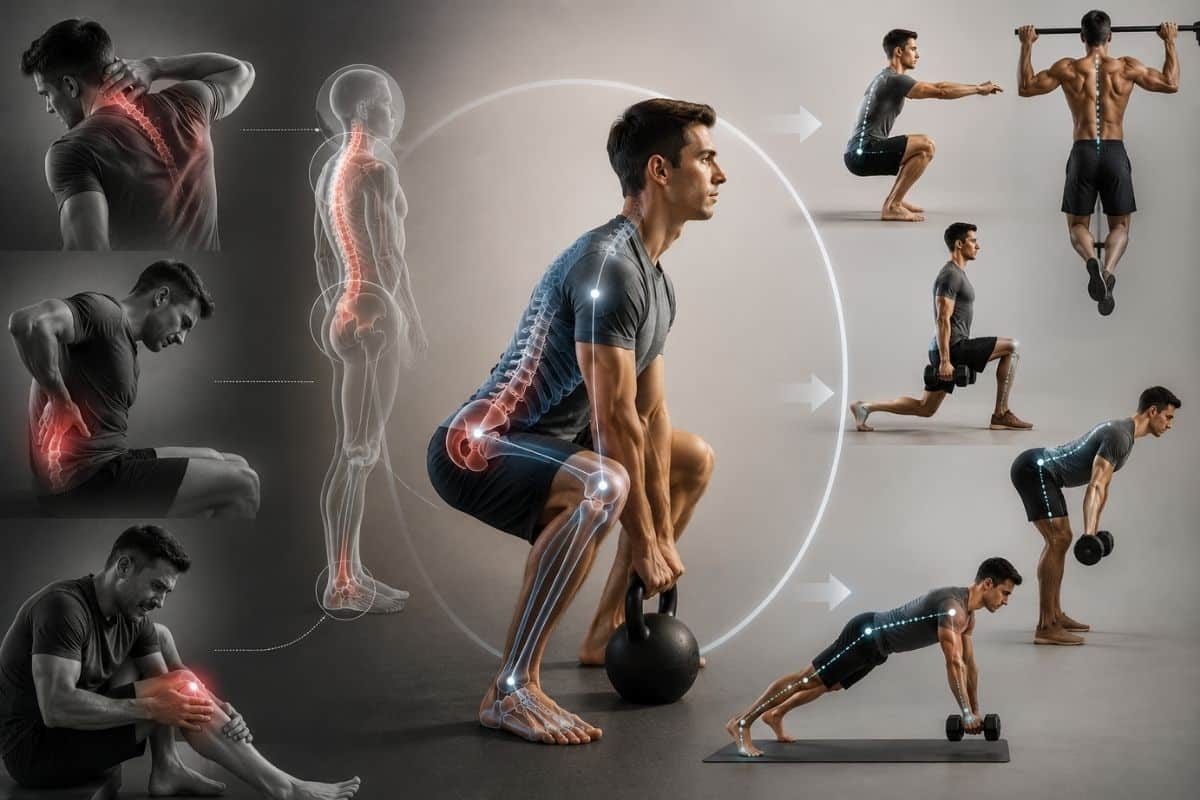
Modern fitness culture often rewards intensity.
Heavier weights, faster workouts, harder training, and higher repetition counts are commonly seen as indicators of progress. While intensity can improve performance, intensity alone does not guarantee healthy movement.
The body does not simply respond to load.
It responds to how load is organised and distributed during movement.
This is why some people develop pain or injury from relatively simple activities, while others tolerate significant physical demand without problems.
The difference is often movement quality.
Understanding movement quality is essential for long-term strength, performance, and injury prevention.
1. Why Movement Exists in the First Place
Human movement exists to help the body complete tasks efficiently under load.
Everyday activities such as:
- walking
- turning the head
- reaching for an object
- climbing stairs
- lifting
- running
depend on coordinated movement between joints, muscles, posture, balance, and the nervous system.
Most of these actions occur automatically.
You do not consciously calculate how to turn toward a sound or how to reach for a glass of water. The nervous system organises movement patterns efficiently through repetition and adaptation.
At its foundation, movement requires:
- joint mobility
- muscular coordination
- postural control
- balance
- force transfer
When these systems work together efficiently, movement feels smooth, stable, and controlled.
The body can distribute load appropriately throughout the kinetic chain.
People who want to understand these movement foundations in greater depth can explore Abbysan’s Yoga Teacher Training, which develops awareness of alignment, balance, mobility, breathing, and controlled movement.
2. How Compensation Replaces Natural Movement
The body is highly adaptable.
When natural movement becomes compromised due to:
- injury
- weakness
- stiffness
- poor posture
- fatigue
- mobility restriction
- muscular imbalance
the body often finds alternative ways to complete the task.
These alternatives are known as compensations.
For example:
- limited hip mobility may increase lower-back movement
- weak gluteal muscles may overload the knees
- poor thoracic mobility may increase stress at the shoulders or neck
Initially, compensation may not create obvious pain or dysfunction.
The body can often tolerate inefficient movement temporarily.
However, compensation changes how forces are distributed through joints and tissues.
Over time, repeated compensation increases mechanical stress and movement inefficiency.
The body still completes the task, but at a greater physiological cost.
3. What Movement Failure Really Means
Many injuries occur during relatively ordinary activities.
People often say:
- “I only lifted a light box.”
- “I moved the wrong way.”
- “The exercise wasn’t even heavy.”
In many cases, the issue is not the object or movement itself.
The issue is that the body could no longer tolerate load efficiently because movement quality had already deteriorated.
This can be described as movement failure.
Movement failure occurs when the body loses its ability to:
- distribute force efficiently
- stabilise joints effectively
- transfer load through the kinetic chain
- coordinate movement under stress
At this point, even relatively small forces may overload tissues.
The problem is rarely one isolated muscle.
It is usually a breakdown in movement organisation.
A systematic review of movement-quality screening and lower-extremity injury risk examined whether compensation, asymmetry, impairment, and inefficient movement control may help identify increased injury risk.
4. Why Load Magnifies Poor Movement
Load itself is not necessarily dangerous.
The body is designed to adapt to force, resistance, and physical challenge.
However, load magnifies whatever movement pattern already exists.
Efficient movement under load usually strengthens the body.
Poor movement under load usually increases compensation and stress.
A simple example is lifting a weight with both hands compared to lifting it with one hand.
Immediately, the body must recalibrate:
- posture
- balance
- muscular activation
- load distribution
- joint stabilisation
This demonstrates that movement organisation determines how effectively the body can tolerate force.
When posture, alignment, and muscular coordination are inefficient, increasing intensity often amplifies dysfunction rather than improving performance.
This is why intensity without movement quality may contribute to:
- joint irritation
- muscular overuse
- stiffness
- recurring injury
- reduced recovery capacity
Intensity does not create problems alone.
Poor movement quality under intensity does.
5. Why Efficient Movement Creates Long-Term Performance
Efficient movement allows the body to:
- distribute load effectively
- activate muscles appropriately
- stabilise joints efficiently
- conserve energy
- recover more effectively
When movement quality improves, the body becomes more adaptable and resilient under physical demand.
Strength becomes more functional because force transfers efficiently through the entire system rather than overloading isolated areas.
This is why long-term performance is not built only through harder training.
It is built through better movement organisation.
A systematic review of neuromuscular training in sports-injury rehabilitation assessed proprioceptive and neuromuscular exercise approaches used for ankle, knee, and shoulder rehabilitation.
At Abbysan, movement therapy and kinesiotherapy focus on restoring:
- posture and alignment
- joint control
- muscular coordination
- load distribution
- movement efficiency
The goal is not simply to increase intensity.
The goal is to create a body that can tolerate intensity safely and sustainably over time.
A body that moves efficiently is often stronger, more balanced, and more resilient than a body trained only for output.
Movement professionals who want to deepen their clinical reasoning, assessment skills, and understanding of movement restoration can learn more about the Dr Abhishek Mentorship.
Final Thoughts
Intensity is not the enemy.
The body is designed to handle load, force, and physical challenge.
However, movement quality determines whether intensity becomes adaptation or breakdown.
When movement is efficient, the body can distribute force, stabilise joints, and recover more effectively.
When movement quality deteriorates, compensation increases and even simple tasks may eventually overload the system.
In many cases, the key to long-term strength and performance is not simply training harder.
It is learning how to move better first.