You didn’t go into this work to feel uncertain. You trained, you practised, you built a client base. You’re good at what you do.
And then a pain client walks in — chronic lower back, failed physio, three opinions and no answers — and something shifts. You can feel the edges of what you know.
This isn’t a failure of skill. It’s a failure of the toolkit most movement training provides.
The toolkit problem
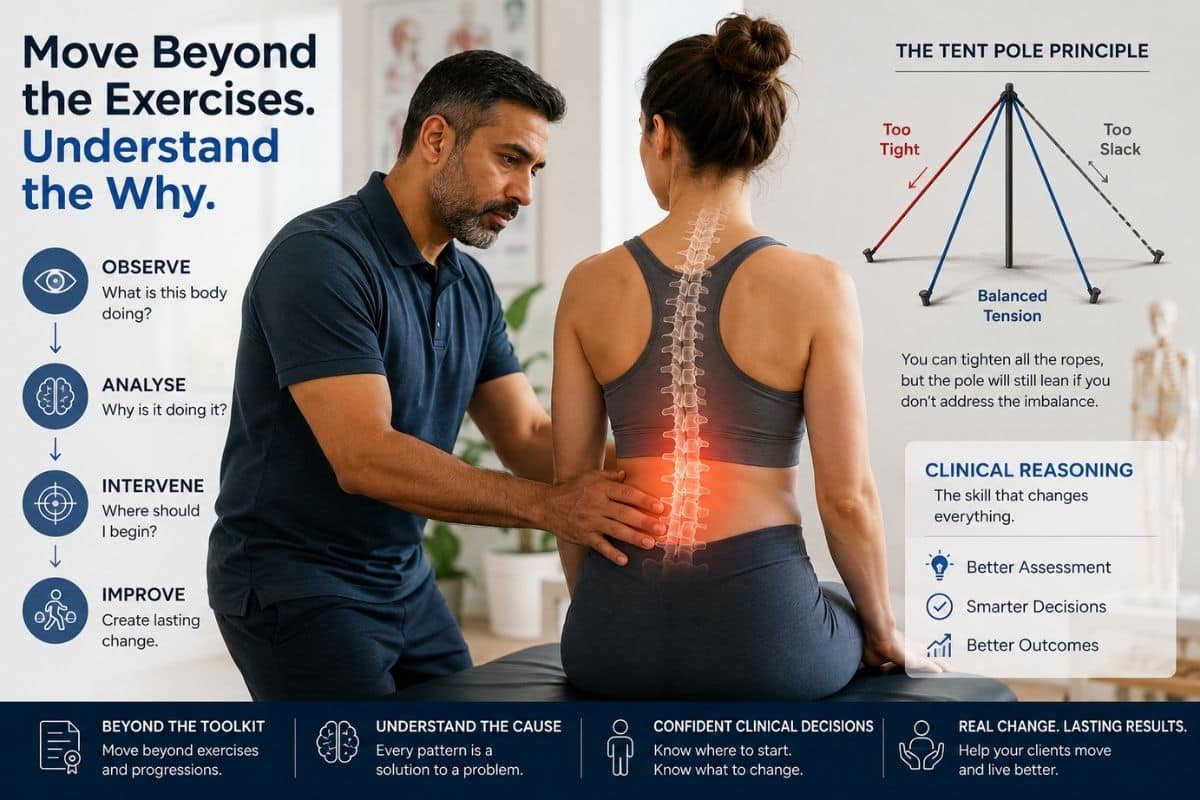
Think of a tent pole held up by ropes on all sides. If the ropes are pulling unevenly — one side too tight, one too slack — the pole leans. You can tighten all the ropes you want. The pole still leans, because you’re working on the tension without addressing where the imbalance is coming from.
Most movement training gives you ropes to tighten. It gives you exercises, progressions, cuing strategies, and modifications. What it rarely gives you is a way to read why the pole is leaning in the first place.
With a simple client — someone who’s deconditioned, inconsistent, and just needs to move more — the exercises are enough. The toolkit is sufficient.
With a pain client, it usually isn’t. Because a pain client’s body is already doing something deliberate. It’s guarding, compensating, protecting. Every movement pattern you see is the result of a decision the nervous system made, often years ago, to manage a threat. Until you understand what that decision was and why it was made, you’re working around the edge of the problem — not at its root.
What clinical reasoning actually is
Clinical reasoning is the skill of moving from observation to hypothesis to intervention. It’s asking: what is this body doing? Why is it doing it? What does that tell me about where to begin?
It’s not a diagnosis. It’s a way of reading. And it changes everything about how you approach a session with a client who hasn’t responded to the standard approach.
Without it, most movement professionals do one of two things with complex pain clients: they stay very conservative and hope the movement helps, or they cycle through exercises looking for the one that works. Both approaches can produce results. Neither is efficient, and neither builds real confidence.
With it, you walk into a session with a framework. You know what you’re looking for. You make deliberate choices, and you understand why you’re making them. And when something doesn’t work, you know what to adjust — not what to add.
This is a learnable skill
Clinical reasoning isn’t reserved for physiotherapists or sports medicine practitioners. It’s a skill that any movement professional can develop — with the right cases, the right feedback, and guided exposure to complex presentations.
The reason it’s rare in yoga and Pilates training isn’t that it’s out of reach. It’s that it’s hard to teach in a group format, and most certifications aren’t built for it.
I work with movement professionals one-on-one to develop exactly this — the ability to read a complex body and make confident clinical decisions about where to start.
If you’re working with pain clients and want to stop guessing, this is where to begin → abbysan.com/dr-abhishek-mentorship/
Dr Abhishek Agrawal is a Clinical Movement Specialist based in Phuket, Thailand.