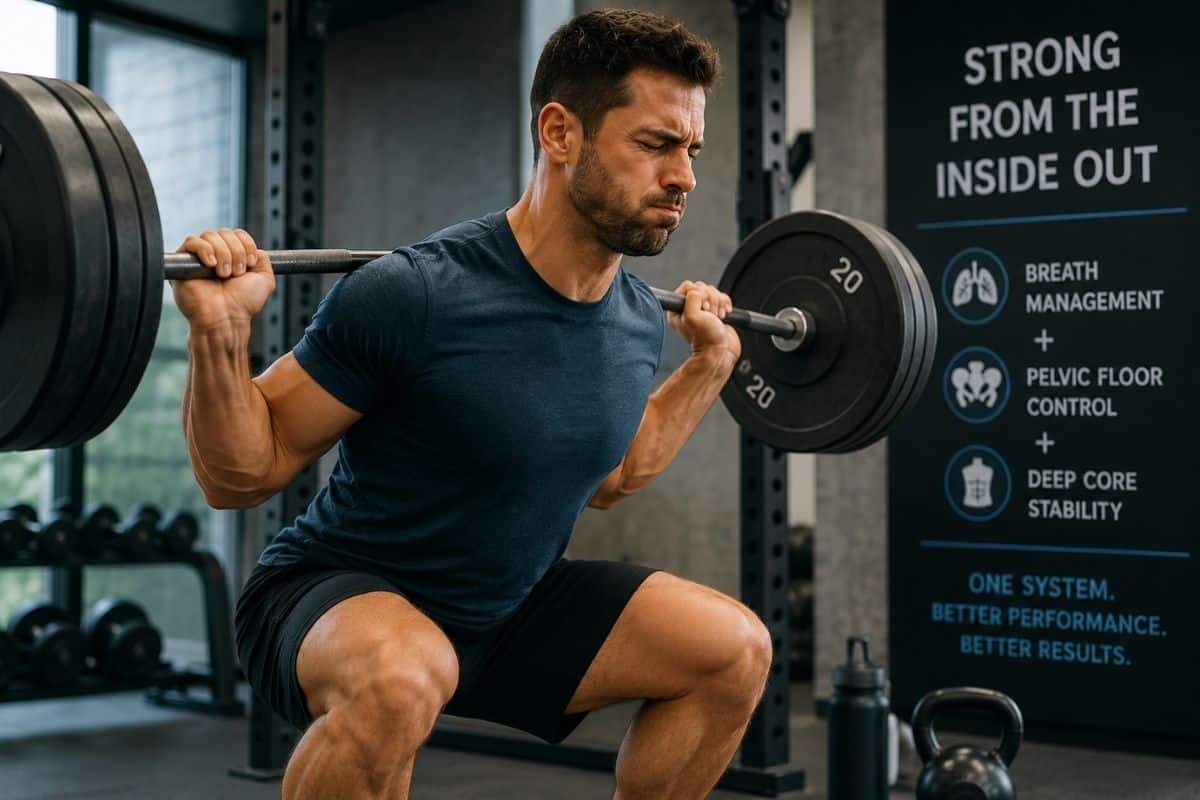
You lift heavy at the gym, brace hard, and hold your breath through the last rep. You may have noticed a small leak on the heaviest sets, or a nagging lower back that never quite settles, no matter how much you strengthen it.
Yet almost every conversation you find about the pelvic floor seems to focus on women after pregnancy. That can make it easy to assume the pelvic floor has little relevance to men’s movement or training.
In reality, men also rely on coordination between the breath, pelvic floor and deep core whenever pressure increases inside the torso.
Think of a sailboat. The sail, ropes and mast have to work together regardless of which direction the wind comes from. Your breathing system, pelvic floor and deep core also work together to manage pressure and support movement.
Why Men Are Often Missing From the Pelvic Floor Conversation
Pregnancy and childbirth naturally bring more attention to pelvic floor function, which is one reason the subject is frequently associated with women’s health.
Men, however, also create significant changes in intra-abdominal pressure when lifting heavy weights, bracing, coughing or performing demanding physical tasks.
Pelvic floor dysfunction can affect men as well as women. The Cleveland Clinic notes that pelvic floor dysfunction can occur in people of any gender and may affect bladder, bowel and other pelvic functions.
What Can Happen When Coordination Is Missing?
A small urine leak during a heavy lift should not automatically be dismissed as an awkward inconvenience. It can be a reason to look more closely at how pressure is being managed during effort.
The pelvic floor does not work alone. Breathing mechanics, abdominal control and the way you brace can influence how forces move through the trunk during demanding activity.
Men may also become particularly aware of pelvic floor function during recovery from prostate treatment or surgery, when bladder control and pelvic floor rehabilitation can become important parts of recovery.
Persistent lower-back discomfort can have many possible causes, so it should not automatically be attributed to the pelvic floor. However, assessing how the breath, trunk and pelvic floor coordinate may provide useful information when movement continues to feel poorly organised despite strengthening.
What Does Pelvic Floor and Core Integration Look Like for Men?
The goal is not simply to perform endless isolated pelvic floor contractions.
Instead, training can focus on coordinating breathing, pelvic floor activity and deep trunk control during the movements that actually matter.
That might mean learning how pressure changes during a heavy lift, a plank, an overhead carry or another demanding movement. Rather than relying entirely on aggressive bracing or prolonged breath-holding, the aim is to develop a more coordinated response to load.
At Abbysan, the Reconnect Method focuses on integrating breath, pelvic floor and core function so these areas can work together during real movement and increasing demands.
Train the System, Not Just the Muscles
Strength matters, but strength without coordination does not always solve the problem.
A strong abdominal wall does not necessarily mean pressure is being managed effectively. Likewise, being able to contract the pelvic floor in isolation does not guarantee that it responds appropriately during a heavy lift or sudden increase in load.
The aim is to train the system so breathing, pelvic floor function and core control contribute together when the body needs them.
If lifting, straining or demanding exercise produces leaking or makes your trunk feel poorly coordinated, it is worth assessing rather than continually working around the symptom.
Train Your Breath, Pelvic Floor and Core as One System
Book a Reconnect Method session with Denny Jumpaon to explore how your breathing, pelvic floor and deep core coordinate during exercise and everyday load.