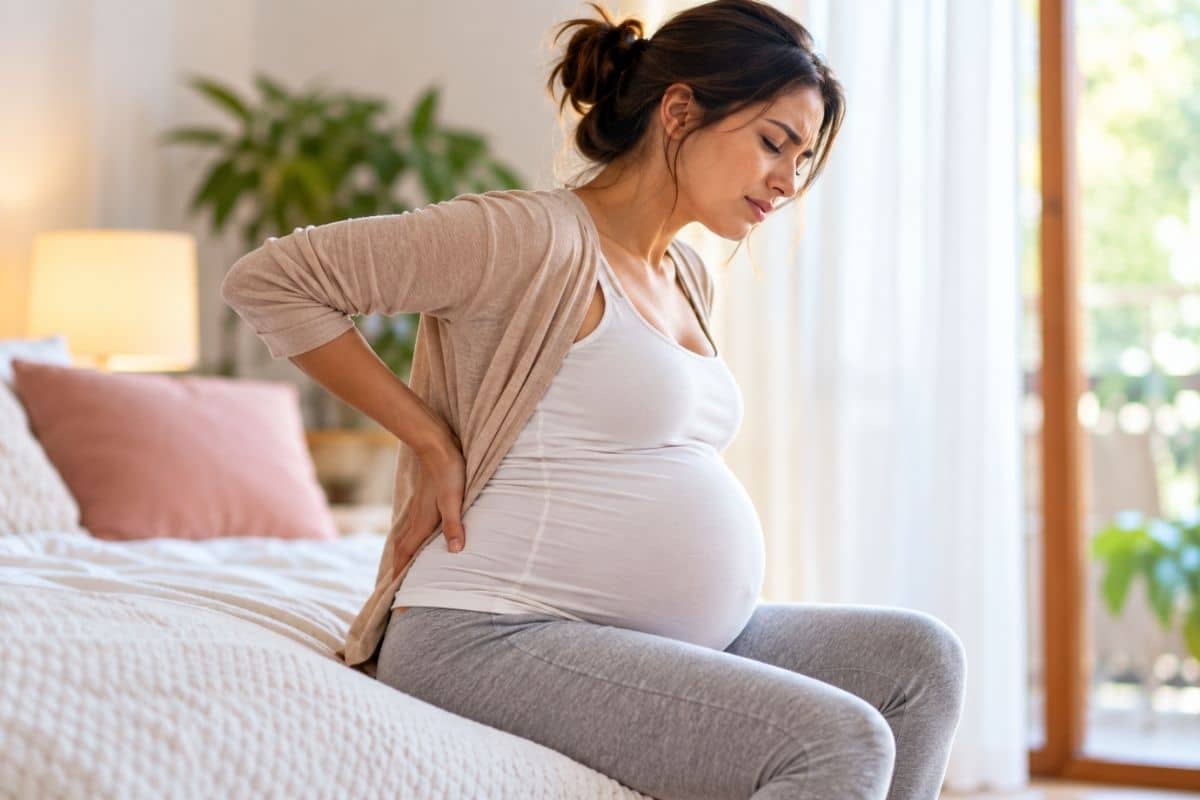
Knock over the first domino in a line and the pieces further along take the hardest fall, reacting to a force applied somewhere else entirely. By the third trimester, a growing baby shifts your center of gravity forward, and the common explanation for the back pain that follows is simply the added weight itself. Weight alone rarely explains why the pain concentrates so specifically in the lower back, or why some women in their third trimester have almost none of this pain while others struggle to get through a full day standing.
The actual chain of events usually starts with the deep core, specifically the abdominal muscles that stretch considerably to accommodate a growing uterus. As these muscles lengthen, they become mechanically less able to support the spine the way they did earlier in pregnancy, and the lower back has to pick up a larger share of the stabilizing job those muscles used to handle. This is the first domino falling, not the baby’s weight itself but the reduced support capacity of a stretched deep core system trying to manage that weight.
The second domino is postural compensation. As the belly grows and the center of gravity shifts forward, many women unconsciously lean back through the upper body to counterbalance, which increases the curve in the lower back and compresses the joints there more than they were designed to handle for sustained periods. This compensation happens gradually and automatically, without any conscious decision, which is why so many women are surprised to learn their own posture has shifted as dramatically as it has by the third trimester.
The First Area: Deep Core Support During Pregnancy
The first area to address is deep core support given the physical constraints of a full-term pregnancy, working with breath and gentle engagement patterns that a stretched abdominal wall can still access, rather than exercises designed for a body that is not pregnant.
The Second Area: Postural Retraining for a Shifting Center of Gravity
The second area is postural retraining specifically for the forward-shifted center of gravity, teaching the body to distribute weight through the hips and legs more evenly rather than compensating entirely through an over-arched lower back.
The Third Area: Hip and Glute Strength
The third area is hip and glute strength, since strong hips and glutes share load with the lower back during standing, walking, and the frequent position changes late pregnancy demands, reducing how much the lower back has to compensate on its own.
For additional guidance on managing discomfort during pregnancy, the NHS guidance on back pain in pregnancy provides practical information about posture, gentle movement, and when to seek medical advice.
Third-trimester back pain has an identifiable mechanical chain behind it, and it responds well to the right, gentle guidance rather than simply being endured until delivery. Reach out to us to arrange a session with Denny, our specialist in the Reconnect Method, who works specifically with prenatal movement and posture.
Back pain during the third trimester can make standing, walking, and everyday activities uncomfortable. With your maternity care provider’s approval, a personalised prenatal movement assessment with Denny can help explore posture, core coordination, and hip strength to support greater comfort during pregnancy.