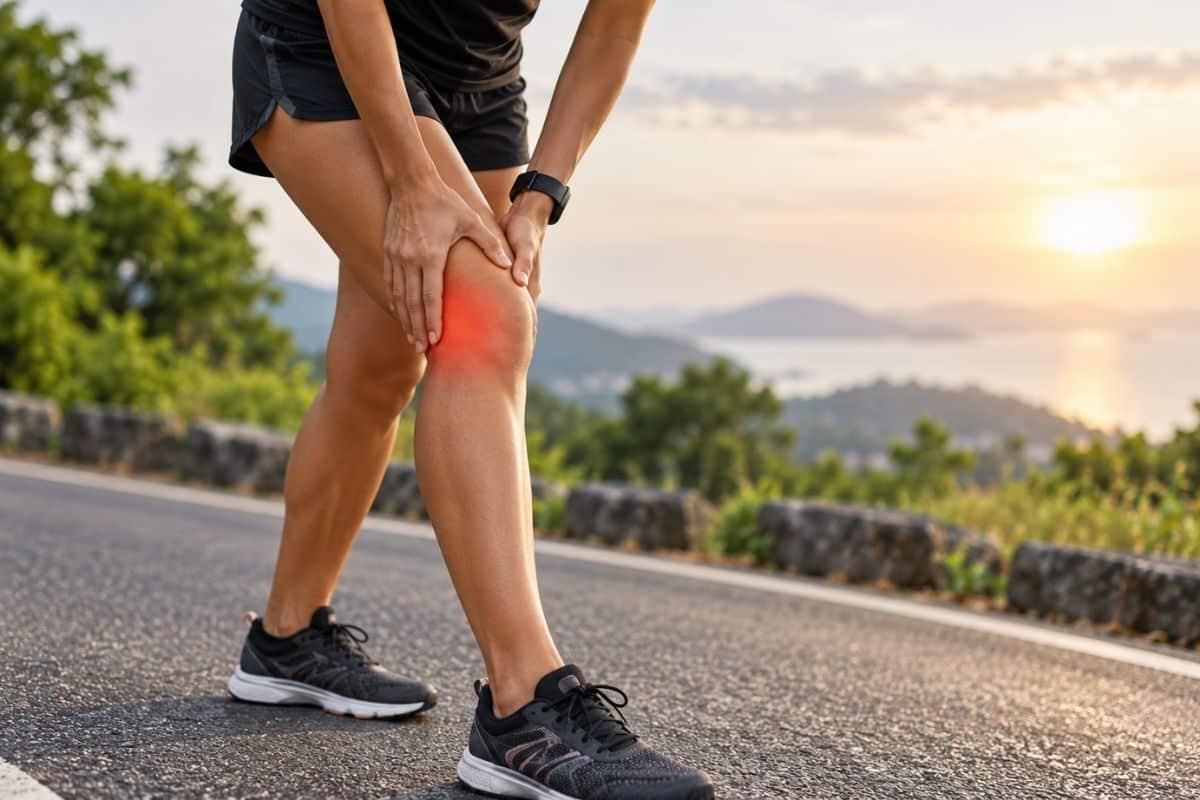
A sharp pain on the outside of your knee appears at roughly the same point in every run. It may become more noticeable when running downhill or as your weekly mileage increases.
You have foam rolled the outside of your thigh regularly. It may feel better temporarily, but the discomfort returns when you start running again.
This pattern is commonly associated with iliotibial band syndrome (ITBS), an overuse condition frequently seen in runners. Although the pain is felt around the IT band and outside of the knee, several factors involving training load, hip function and lower-limb mechanics may contribute.
Why Foam Rolling May Only Offer Temporary Relief
Foam rolling can temporarily change how tight or uncomfortable the outside of the thigh feels, but it does not necessarily address the factors contributing to recurring IT band symptoms.
The iliotibial band is a strong band of connective tissue extending along the outside of the thigh. Unlike a muscle, it is not something that can simply be stretched into permanently becoming “looser.”
If symptoms consistently return during running, it may be more useful to examine training load, hip strength and control, and overall running mechanics rather than repeatedly treating the painful area alone.
What Could Be Happening at the Hip?
The muscles around the hip play an important role in controlling the pelvis and thigh during running.
When you land on one leg, your hip muscles help manage the position of the pelvis and lower limb. Differences in strength, coordination or movement control may influence how forces are distributed through the leg.
This does not mean that weak glutes are responsible for every case of IT band syndrome. Running volume, sudden changes in training, downhill running and individual biomechanics can all contribute to symptoms.
Why Downhill Running Can Feel Worse
Many runners with IT band symptoms notice that downhill sections aggravate the outside of the knee.
Running downhill changes the mechanical demands placed on the lower limb and requires the muscles to manage braking forces repeatedly. When an already irritated area is exposed to these repeated loads, symptoms may become more noticeable.
This is one reason reviewing your recent training changes can be just as important as examining the painful area itself.
Why Hip Strength and Movement Control Matter
Assessing how the pelvis, hip, knee and foot behave during single-leg movements can provide useful information about how your body manages running-related loads.
When appropriate, rehabilitation may include progressive hip and lower-limb strengthening, movement retraining and gradual modification of running volume rather than focusing exclusively on stretching or foam rolling.
The goal is not simply to strengthen one muscle. It is to improve your overall capacity to tolerate the repeated demands of running.
At Abbysan, a Foundation Assessment can examine your strength, mobility and movement patterns to help identify factors that may be contributing to recurring symptoms.
Look Beyond the Painful Spot
If the same area on the outside of your knee repeatedly becomes painful despite regular foam rolling, it may be time to look beyond the IT band itself.
Understanding your training load and how your hip, knee and foot work together can provide a clearer direction for rehabilitation and your return to comfortable running.
Find Out What Is Contributing to Your IT Band Pain
Book a Foundation Assessment to explore your hip strength, lower-limb movement and running mechanics and identify factors that may be contributing to recurring IT band symptoms.