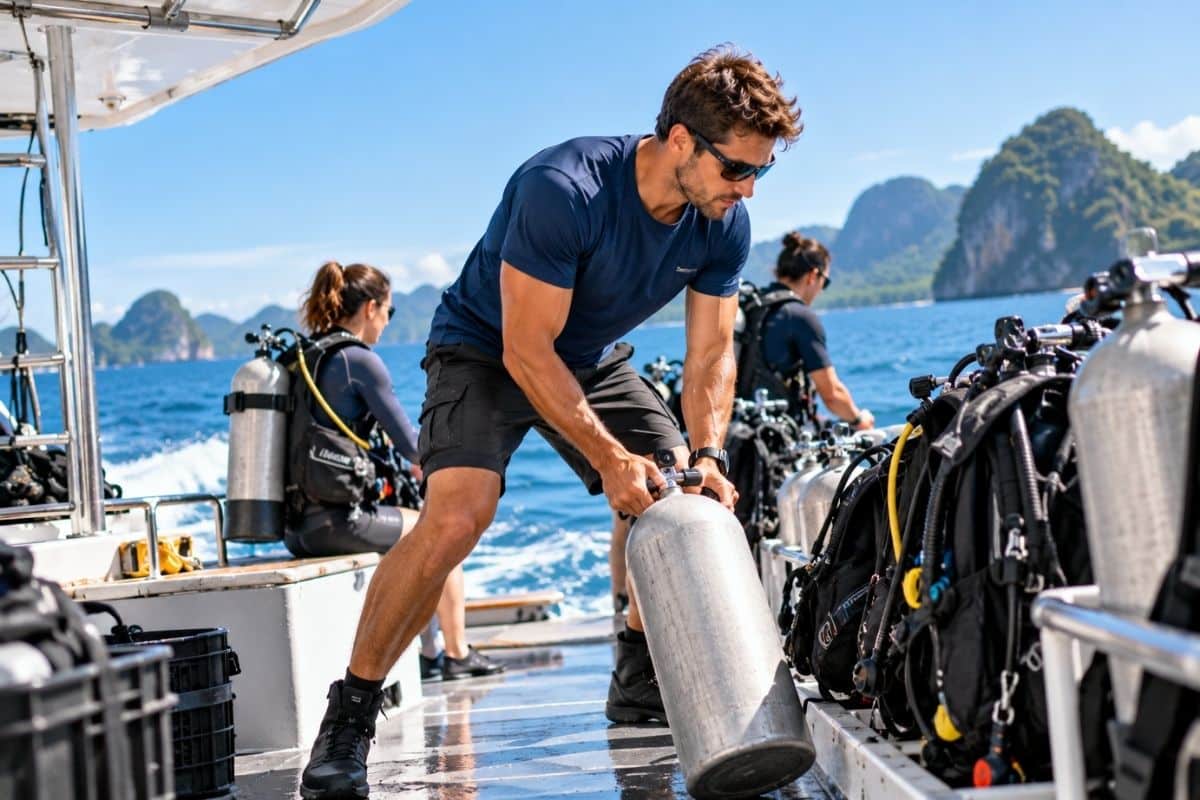
A sailboat does not fight the wind. It is built so that no matter which direction the wind blows, the balance between the sail, the ropes, and the mast drives it forward, constantly adjusting rather than resisting. A body working on a moving boat deck all day, handling tanks, guiding divers, hauling lines, has to make that same constant adjustment through the legs and core, hundreds of times a shift, whether the water is calm or rough. On land, this kind of full-body stabilizing effort simply does not exist, which is why dive instructors and boat crew develop a pattern of fatigue and pain that looks unlike almost any other hospitality role in Phuket.
Standing or moving on a surface that shifts under you activates small stabilizing muscles through the ankles, hips, and deep core almost continuously, even during tasks that look completely still from the outside. Most bodies are not conditioned for this kind of sustained, low-level stabilizing demand, because most daily movement, even other physically demanding jobs, happens on a fixed surface. Add the actual physical labor of the role, lifting tanks, hauling anchor lines, helping divers in and out of the water, and the deck becomes a place where every task carries a hidden stabilization tax on top of its obvious physical demand.
This is why so many people in these roles describe a whole-body fatigue that feels different from ordinary muscle soreness, along with specific complaints in the lower back and ankles that standard ergonomic advice, built for people working on solid ground, does not really address.
The First Area: Ankle and Hip Stability Under Unpredictable Load
The first area to assess is ankle and hip stability under unpredictable load, since these joints are doing the bulk of the moment-to-moment balancing work that a moving deck demands, work that never gets specifically trained unless someone identifies the gap directly.
The Second Area: Deep Core Endurance
The second area is deep core endurance rather than peak core strength, because the demand on a boat is not a single strong brace but a low-level, sustained engagement that has to hold up for an entire shift, a very different quality of strength than what most core training programs build.
The Third Area: Lifting Mechanics on an Unstable Surface
The third area is lifting mechanics specific to an unstable surface, since technique that works well when lifting a tank on solid ground changes considerably when the surface underneath is also moving, and this difference is rarely addressed in general lifting guidance.
For broader guidance on preventing work-related musculoskeletal strain, the NIOSH ergonomics resources explain how physical work demands and workplace conditions can contribute to muscle and joint problems.
Work on the water asks more of the body’s stabilizing system than almost any land-based role, and it deserves training that reflects that. Come see us for a movement assessment so we can help your body handle the deck the way the deck actually demands.
Working on a moving boat places continuous demands on your balance, core endurance and lifting control. A Foundation Assessment can help identify stability limitations and movement patterns that may contribute to fatigue or discomfort during long shifts at sea.