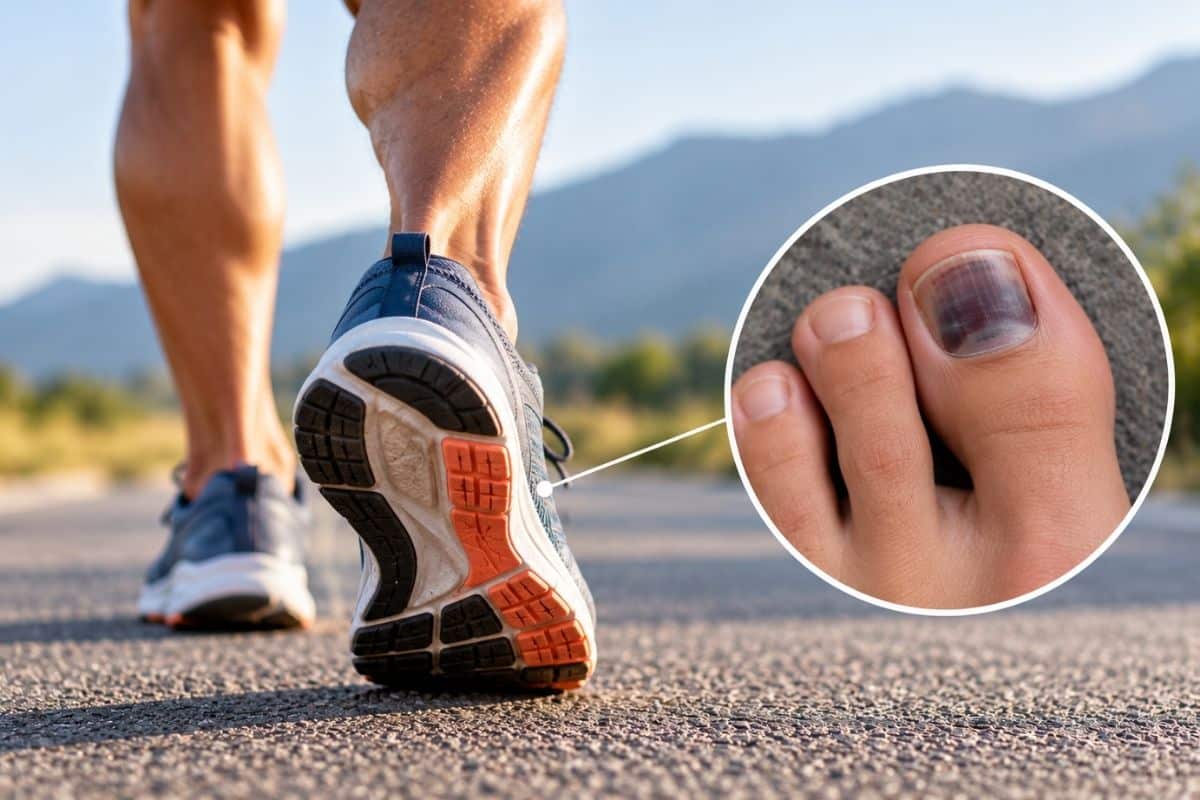
Muscles and joints work like a rope and pulley. When the muscle on one side weakens, the opposite side pulls harder, and the joint shifts, with the imbalance compounding from there. A blackened, bruised toenail is usually treated as a minor cosmetic nuisance of distance running, something to shrug off and forget about once it grows out. It is actually a small, visible signal at the very end of a chain, showing that your foot is doing something upstream that keeps driving your toe repeatedly into the front of your shoe.
Runner’s toe happens when the toe repeatedly jams forward inside the shoe during the push-off phase of running, bruising the nail bed under the resulting pressure. The most common explanation offered is simply that the shoes are too small or laced too loosely, and sometimes that is genuinely the whole story. Just as often, the actual cause is upstream in the kinetic chain: a foot that overpronates, rolling inward more than it should during stance, pushes the toes forward at a different angle and with different timing than a foot with normal mechanics, driving the same toe into the same spot inside the shoe, run after run, regardless of how well the shoe fits.
This is why some runners can switch to a roomier shoe and still bruise the same toenail repeatedly, while others run in a snug shoe for years without any issue at all. The shoe is only one link in the chain. If your foot’s mechanics are pushing that toe forward with excess force, a bigger shoe simply gives the same problem more room to happen before it becomes visible.
The First Area: Foot Mechanics During the Stance Phase
The first area to assess is how your foot rolls through the stance phase of your stride, checking whether overpronation or an uneven weight distribution across your foot is pushing force toward one specific toe more than the others.
The Second Area: Push-Off Mechanics and Toe Pressure
The second area is push-off mechanics specifically, since the way your foot leaves the ground, straight through the big toe versus rolling off to one side, changes which toe absorbs the repeated forward pressure that eventually causes the bruising.
The Third Area: Running Shoe Fit and Lacing Technique
The third area is shoe fit and lacing technique relative to your actual foot mechanics, which matters, but only as one part of the picture rather than the whole explanation, since even a well-fitted shoe cannot fully compensate for a foot mechanically driving itself forward inside it.
For additional guidance on running-related foot problems, the American Orthopaedic Foot & Ankle Society’s FootCareMD provides educational resources about foot and ankle health, common injuries, and treatment considerations.
A bruised toenail is a small, visible clue about a larger pattern worth understanding properly. Come see us for a movement assessment so we can find out what your foot is actually doing with every stride.
Recurring black toenails can make running uncomfortable and may indicate repeated pressure inside your shoes. A Foundation Assessment can help examine your foot mechanics, running technique, and movement patterns to identify potential contributing factors.