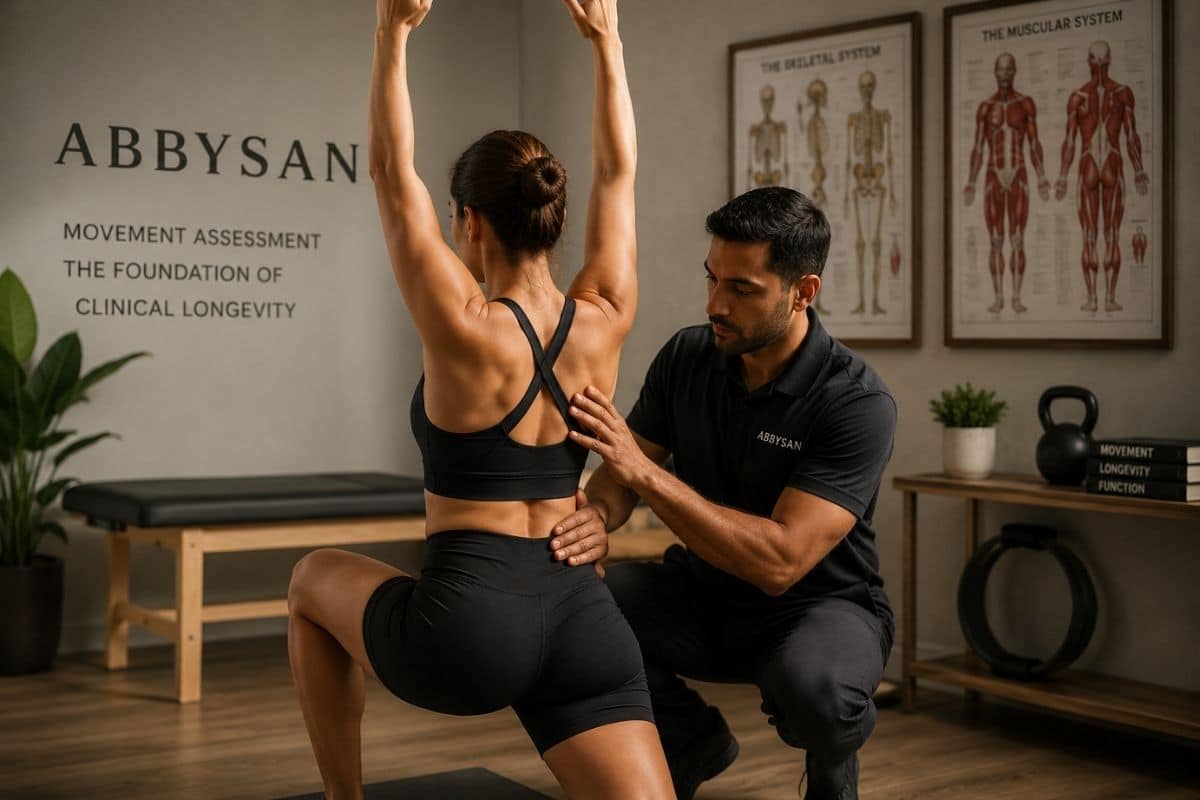
You do not feel unwell. You just feel more careful than you used to. The stairs get a longer look before you take them. Getting up from the floor takes a plan instead of a movement. Nothing hurts exactly. You have simply started moving like someone bracing for something.
That bracing is not age showing up. It is a body that has been losing ground quietly for years, with nobody stopping to check where.
When you were in the womb, your body sat curled forward, folded into itself. In old age, without anything pushing back, it slowly returns to that same shape. Gravity does not pause in between. Movement is the only real resistance to that pull.
Stiffness Is a Measurement, Not a Stage of Life
Every year, without deliberate movement, gravity and disuse win a little more ground. A hip stops turning as far as it used to. A shoulder stops reaching overhead without help from the ribs. A spine gives up part of its natural curve and adopts another pattern instead.
None of this arrives as a single symptom. It arrives as a slow narrowing of what your body is willing to attempt, and many people mistake that narrowing for simply getting older.
Research from the National Institute on Aging shows that maintaining mobility, balance and regular movement is one of the most effective ways to support healthy ageing and preserve independence.
Rather than being simply about age, the body follows a gradual arc of change, and that arc can be measured through movement.
What a Movement Assessment Actually Checks
A Foundation Movement Assessment is not a fitness test. Nobody is measuring how much you can lift or how far you can run.
Instead, it is a detailed evaluation of where your body currently sits on that arc.
How far does your hip actually rotate before your lower back begins compensating? How well does your spine maintain its natural movement? How does your breathing influence posture while standing still?
These observations reveal areas where you have lost movement, developed compensation patterns and still maintain efficient function.
Comprehensive movement assessments are widely used by physiotherapists to evaluate posture, mobility, joint mechanics and movement quality before creating an individual treatment plan. Learn more about Movement Assessment on Physiopedia.
Those findings shape what comes next. Not a generic exercise programme, but a plan built around your body’s specific movement needs.
Why This Is the Foundation, Not a Phase
Most people wait until pain appears before investigating how they move. By then, the movement changes have often been developing for years.
That is why Abbysan begins with a Foundation Assessment rather than jumping directly into treatment or exercise.
By understanding how your body functions today, the assessment helps create a programme that builds resilience instead of constantly reacting to problems after they appear.
For people looking to stay active, capable and independent for as long as possible, Abbysan’s approach to Clinical Longevity in Phuket begins with understanding how your body currently moves before deciding what it needs next.
Know Where Your Movement Stands Today
Book a Foundation Movement Assessment to discover how your body is adapting, where movement has been lost, and how a personalised plan can help you build long-term mobility and resilience.
