Lumbar lordosis is one of the most common findings in a movement assessment. It’s also one of the most misread.
The moment a practitioner sees an exaggerated lumbar curve, the instinct is usually the same — stretch the hip flexors, strengthen the core, cue a posterior pelvic tilt. It’s a reasonable response. But it’s a response to the shape, not to the cause. And the cause is almost never the same twice.
The lordosis is not the problem. It’s the body’s solution to a problem. The question worth asking is: what problem is it solving?
The rope and pulley
Muscles and joints work like a rope and pulley. When the muscle on one side weakens, the opposite side pulls harder. The joint shifts. And the imbalance compounds from there.
In the lumbar spine, this plays out in several directions at once. The curve you’re looking at is the result of multiple forces pulling against each other, and which force is dominant changes everything about where you intervene first.
Three different causes, three different starting points
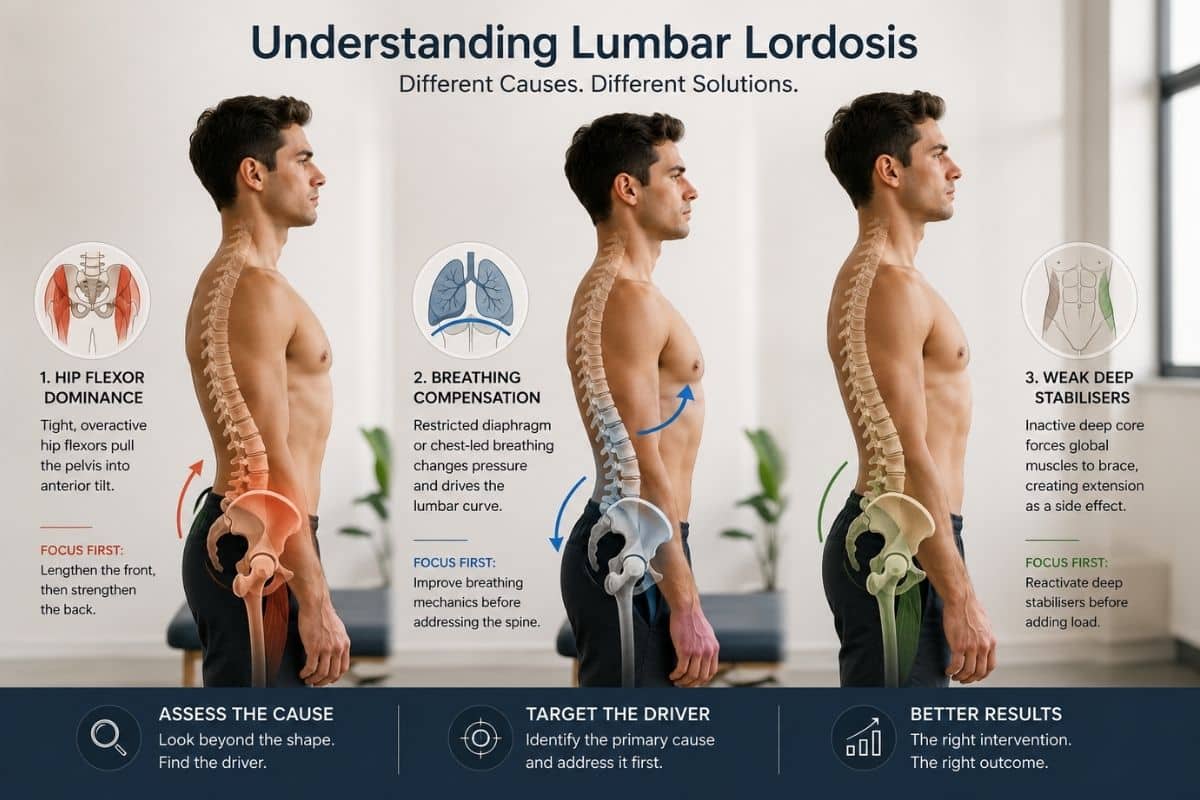
Hip flexor dominance. The hip flexors are chronically shortened and overactive, pulling the pelvis into anterior tilt. The lordosis is positional — the pelvis is being dragged forward by soft tissue tightness at the front. What to look for: limited hip extension in walking, anterior tilt at rest, and difficulty finding a neutral pelvis without effort. Starting point: lengthen the front, then reload the posterior chain.
A breathing compensation. When the diaphragm is restricted or the person habitually breathes into the chest, intra-abdominal pressure changes. The lumbar spine extends to compensate for the shift in pressure mechanics. The lordosis here is respiratory — driven, not by the muscles around the spine, but by the pressure system inside it. What to look for: chest-led breathing, rib flare, tension at the thoracolumbar junction. Starting point: change the breath before you touch the spine.
Weak deep stabilisers. When the deep core — the muscles designed to provide segmental spinal support — is not doing its job, the global muscles of the back take over. They brace to hold the spine upright, creating extension as a side effect. The lordosis here is stability-driven. What to look for: global bracing patterns, breath-holding under load, poor load transfer through the pelvis in single-leg work.
Starting point: Reactivate the deep system before loading the spine.
Why this matters in practice
Each of these presentations looks similar from the outside. All three show an exaggerated lumbar curve. All three may have some degree of hip flexor tightness, some core weakness, some breathing dysfunction — because these things overlap.
But the primary driver is different. And if you treat a breathing-driven lordosis by stretching the hip flexors, you’ll get partial improvement at best. If you treat a stability-driven lordosis by cuing a posterior pelvic tilt, you may actually increase the bracing that’s creating the problem.
This is why practising from observation alone — without reading the cause — produces inconsistent results with complex clients. The pattern looks the same. The intervention needs to be different.
Assessment before everything
The ability to distinguish between these three presentations — to see past the shape and into what’s driving it- is a clinical reasoning skill. It develops with practice, with case exposure, and with guided feedback on what you’re actually seeing.
This is the core of what I work on with movement professionals in my mentorship sessions. Not more exercises. Better reading.
If you’re ready to develop that — I’d like to work with you → abbysan.com/dr-abhishek-mentorship/
Dr Abhishek Agrawal is a Clinical Movement Specialist based in Phuket, Thailand.