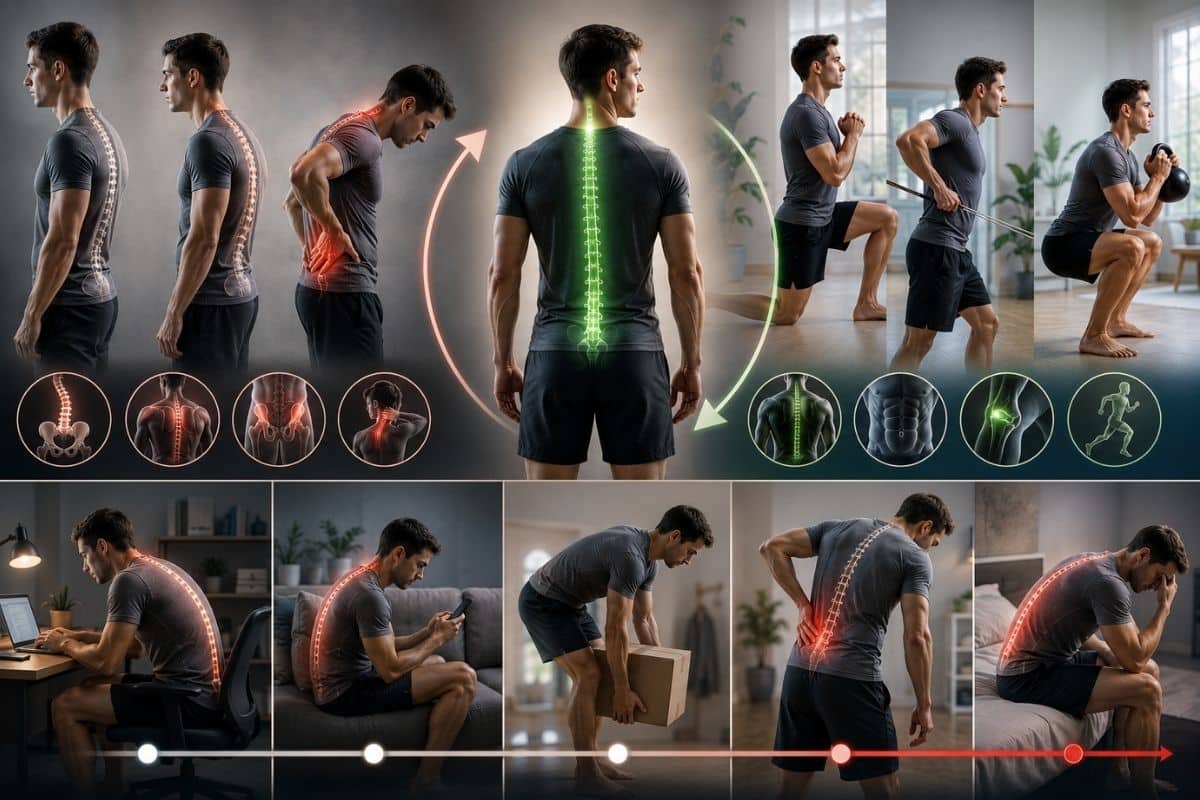
Many people begin exercising or movement therapy and notice positive changes within weeks or months.
Pain reduces. Stiffness improves. Movement feels easier.
However, once exercise stops, the discomfort often begins returning gradually.
This can feel frustrating and confusing.
People often assume:
- the exercises stopped working
- the body became dependent on exercise
- the problem was never fixed properly
In reality, pain often returns because the body naturally falls back into the movement patterns it practised most consistently over many years.
Understanding this process is essential for creating long-term improvement rather than temporary symptom relief.
1. Pain Develops Gradually Over Time
Pain rarely develops overnight. A comprehensive Foundation Session can help identify movement restrictions, postural changes, weakness, and compensation patterns before they progress into persistent discomfort.
In many cases, the painful moment is simply the final stage of a process that has been developing silently for months or years.
Before pain appears, the body often experiences gradual changes such as:
- postural imbalance
- reduced mobility
- muscle weakness
- altered movement mechanics
- compensation patterns
- inefficient load distribution
At first, the body adapts well.
People continue functioning normally because the nervous system constantly finds ways to compensate and complete movement tasks.
However, over time, these compensations increase mechanical stress on joints, muscles, fascia, and connective tissues.
This repeated stress may eventually lead to:
- stiffness
- irritation
- inflammation
- reduced movement efficiency
- pain
This is why many people say:
- “I only lifted something light.”
- “I just bent the wrong way.”
- “The movement wasn’t even difficult.”
The final event is often small.
The dysfunction developing underneath it usually took much longer.
2. How Compensation Becomes the Body’s Normal Pattern
The body is highly adaptable.
When movement becomes inefficient, the nervous system creates compensatory strategies to maintain function and reduce discomfort.
For example:
- weak gluteal muscles may increase lower-back tension
- limited hip mobility may overload the lumbar spine
- poor thoracic movement may increase shoulder strain
Initially, these compensations help the body continue functioning.
Over time, however, they become automatic.
The body begins treating compensation as the “normal” movement pattern.
This creates several problems:
- muscles begin working inefficiently
- joints lose balanced support
- movement becomes less coordinated
- stiffness and fatigue increase
The longer these compensations exist, the more familiar they become to the nervous system.
In many cases, the dysfunctional pattern eventually feels more natural than efficient movement.
3. Why Symptom Relief Is Not the Same as Movement Restoration
When exercise and movement therapy begin improving strength, alignment, and movement quality, symptoms often reduce.
This is an important step.
However, symptom reduction does not necessarily mean the body has fully restored efficient movement organisation yet.
Pain reduction simply means the body is tolerating movement better.
The deeper movement system may still require:
- improved joint control
- better muscular coordination
- stronger postural support
- more efficient load distribution
- long-term movement reinforcement
This is why many people feel significantly better after a few months, but symptoms gradually return once movement maintenance stops.
The body often defaults back towards the movement patterns it practised for years before rehabilitation began.
The nervous system usually prefers familiar movement patterns unless new ones are reinforced consistently over time.
Research available through PubMed on movement-evoked pain and rehabilitation also highlights the importance of evaluating pain during movement rather than focusing only on symptoms experienced at rest.
4. The Importance of Maintaining Alignment and Strength
Exercise in rehabilitation is not only about fitness.
It is also about maintaining movement organisation.
When movement quality improves, the body requires ongoing support to maintain:
- muscular balance
- joint stability
- posture
- mobility
- load tolerance
Without regular movement:
- muscles gradually weaken again
- posture begins deteriorating
- stiffness returns
- compensations increase
- joints lose support
This does not mean the body is “dependent” on exercise.
It means movement is part of maintaining healthy function, just as nutrition, sleep, and circulation are part of maintaining health.
The World Health Organization’s physical activity guidance emphasises the importance of regular physical activity for maintaining health, mobility, strength, and long-term physical function.
The body continuously adapts to what it practises most consistently.
5. Why Long-Term Movement Creates Long-Term Change
The body changes gradually.
Long-standing movement patterns usually require consistent repetition over time to improve sustainably.
This is why long-term movement practice is often more effective than short periods of intense rehabilitation followed by inactivity.
Movement therapy and kinesiotherapy focus not only on reducing pain, but also on helping the body:
- stabilise joints more efficiently
- distribute load more evenly
- improve muscular coordination
- restore posture and alignment
- tolerate movement with less compensation
As these systems improve and are maintained consistently, efficient movement patterns become more automatic.
The goal is not temporary symptom relief.
The goal is long-term movement resilience.
At Abbysan, rehabilitation can follow the Movement Decision System, which focuses on assessing movement, selecting appropriate progressions, improving load distribution, and building long-term physical resilience.
This is why movement is viewed not as a short-term intervention, but as part of maintaining lifelong structural health and function.
Final Thoughts
Pain often returns after stopping exercise because the body naturally falls back into old compensatory movement patterns.
Pain itself may reduce relatively quickly, but restoring efficient movement organisation usually takes much longer.
The body continuously adapts to what it practises most consistently.