By the end of the day, you are tired in a way that has nothing to do with what you actually did. Sitting took effort. Standing up from the chair took effort. Carrying the groceries in from the car took effort. You have been told this is what building strength feels like. It is not. It is what bracing feels like.
Movement therapy that truly works is not about doing more. Instead, it focuses on helping your body use less effort to accomplish the same everyday movements.
A sailboat does not fight the wind. It is designed so the sail, ropes and mast work together to move it forward regardless of the wind’s direction. Your body works in a similar way. When the muscles around a joint share the workload proportionately, your body no longer needs to brace against every movement. It simply moves through it.
Why Does Pushing Harder Keep You Tired?
When one side of a joint already performs more than its fair share of the work, adding more exercise often asks that same side to work even harder.
The overworked muscle becomes more fatigued while the quieter muscle continues contributing very little. What feels like progress may simply be the dominant muscles carrying an even heavier load.
As a result, the exhaustion that follows is often compensation rather than healthy conditioning.
The Cleveland Clinic explains that physical therapy focuses on restoring movement, improving function and reducing pain by addressing the underlying causes of movement limitations rather than simply increasing strength.
What Proportionate Movement Therapy Actually Changes
The goal is not completing more repetitions or lifting heavier weights. Instead, movement therapy redistributes the workload so no single muscle carries the entire task alone.
Once that redistribution happens, ordinary daily movements require noticeably less effort.
Standing up becomes smoother without your lower back doing all the work. Reaching overhead no longer requires your neck to compensate for restricted shoulder movement.
Nothing about the task has changed. What changes is how efficiently your body shares the work.
At Abbysan, every Foundation Movement Assessment identifies how your body currently distributes movement before any corrective programme begins.
What Ease Looks Like When It Returns
Ease does not mean the absence of effort. It means the effort finally goes where it belongs, shared naturally across the body rather than concentrated into one overloaded area.
A well-functioning body moves through an entire day without constantly negotiating every chair, staircase or overhead reach.
That outcome differs from simply becoming stronger. It reflects better movement efficiency, improved coordination and more balanced muscular contribution.
Research published by the American Physical Therapy Association (APTA) highlights movement-based rehabilitation as an important approach for improving function, reducing pain and restoring efficient movement patterns.
If chronic pain has turned every ordinary movement into hard work, adding even more effort is rarely the solution. Understanding where that effort is actually going is often the better place to begin.
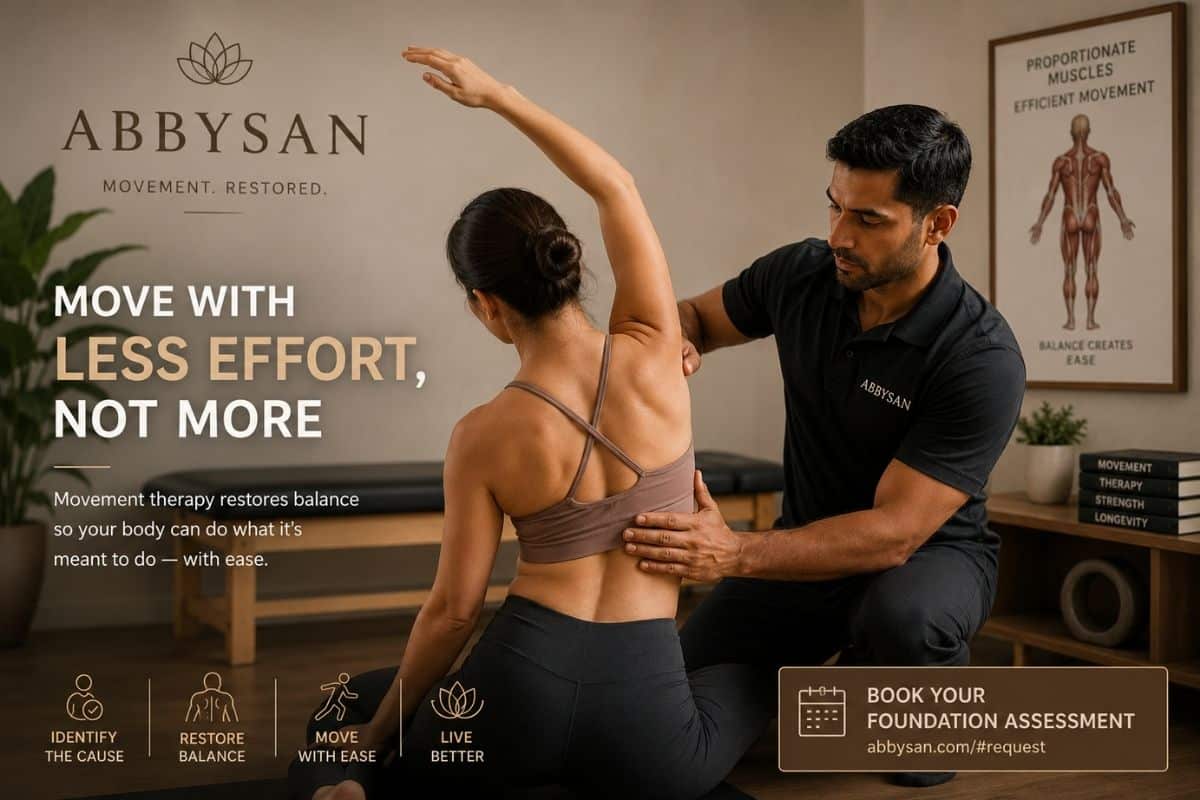
Move With Less Effort, Not More
Book a Foundation Assessment to discover where your body is overworking and how personalised movement therapy can help restore easier, more efficient movement.