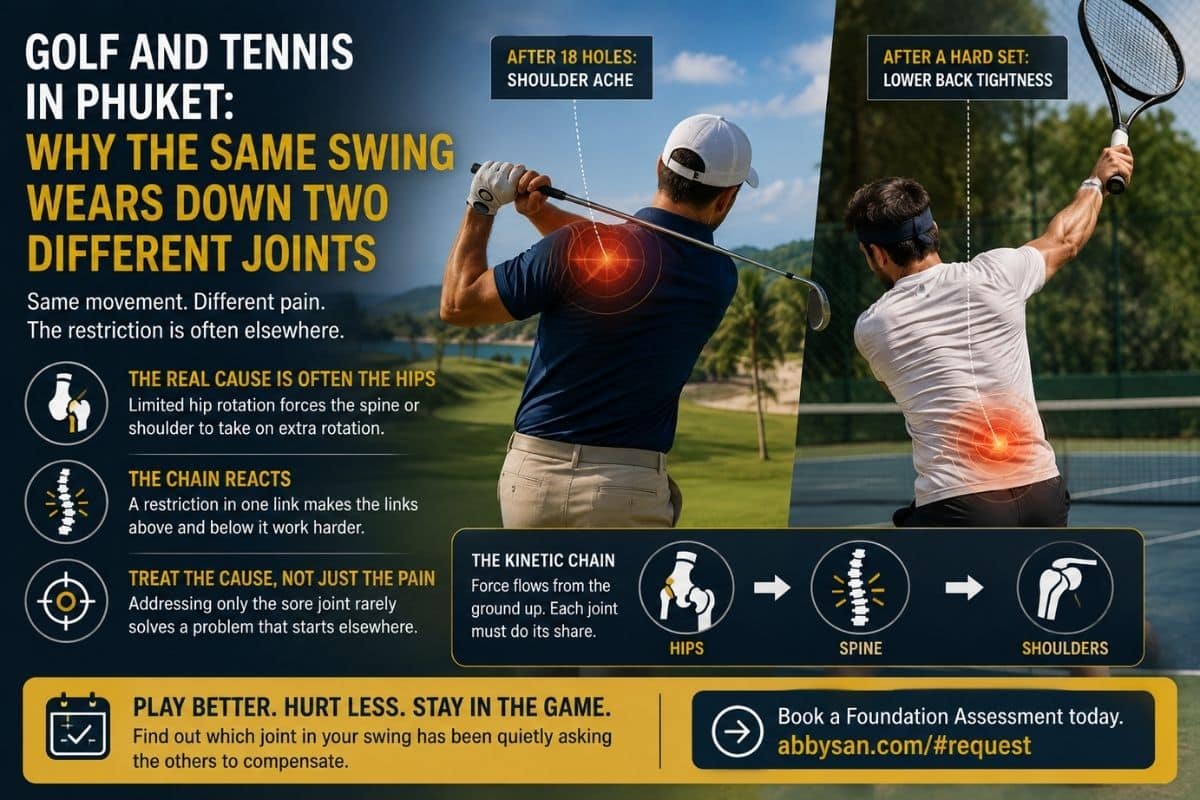
You play golf twice a week, or tennis with the same group most weekends, repeating the same swing hundreds of times in a session.
Lately, your shoulder aches after eighteen holes. Separately, your lower back tightens after a hard set of tennis. They may feel like two different problems, but both can involve how rotational load moves through the body.
Muscles and joints work together as a chain. A golf swing or tennis serve sends rotational force through the hips, trunk and shoulder in sequence, with each area contributing to the movement.
If one part of that sequence contributes less movement or control, another area may have to contribute more.
Why the Same Swing Can Produce Different Problems
Two players with technically similar swings can experience discomfort in completely different places because their bodies may distribute rotational load differently.
One player may have good hip rotation but limited movement elsewhere. Another may have restricted hip mobility and rely more heavily on the lower back to complete the turn.
The swing can look similar from the outside while the movement strategy underneath it is very different.
This is one reason simply identifying the painful joint does not always explain why that joint became irritated.
What Happens Through the Kinetic Chain?
The hips, trunk and upper body contribute to generating and transferring force during rotational sports.
If hip rotation is limited, the body may find another way to complete the movement. The lower back, upper trunk or shoulder can contribute additional motion depending on the individual movement pattern.
Repeated over hundreds of swings, even a relatively small compensation can increase the workload placed on another area.
The American Academy of Orthopaedic Surgeons notes that golf places repetitive demands on several areas of the body and highlights conditioning, flexibility and appropriate technique as important considerations for injury prevention.
Why the Joint That Hurts May Not Tell the Whole Story
A painful shoulder naturally draws attention to the shoulder. A tight lower back makes the back seem like the obvious place to start.
Those areas still need appropriate assessment, but looking only at the painful location can miss how the rest of the movement chain contributes to the symptom.
For example, assessing hip rotation, trunk control and shoulder mobility can provide a clearer picture of how rotational force moves through an individual swing.
At Abbysan, a Foundation Assessment can examine these movement patterns and identify where mobility or control may be affecting how load travels through the body.
Assess the Swing From the Ground Up
The goal is not simply to make one joint more flexible. It is to understand whether each part of the kinetic chain can contribute appropriately to the movement.
For golfers and tennis players, that means looking beyond the shoulder or lower back and examining how the hips, trunk and upper body work together during rotation.
If the same swing repeatedly produces discomfort, the painful joint may be absorbing demand that another part of the chain is not currently sharing effectively.
Find Out Where Your Swing Is Losing Rotation
Book a Foundation Assessment to understand how your hips, trunk and shoulders share rotational load and where compensation may be affecting your performance.