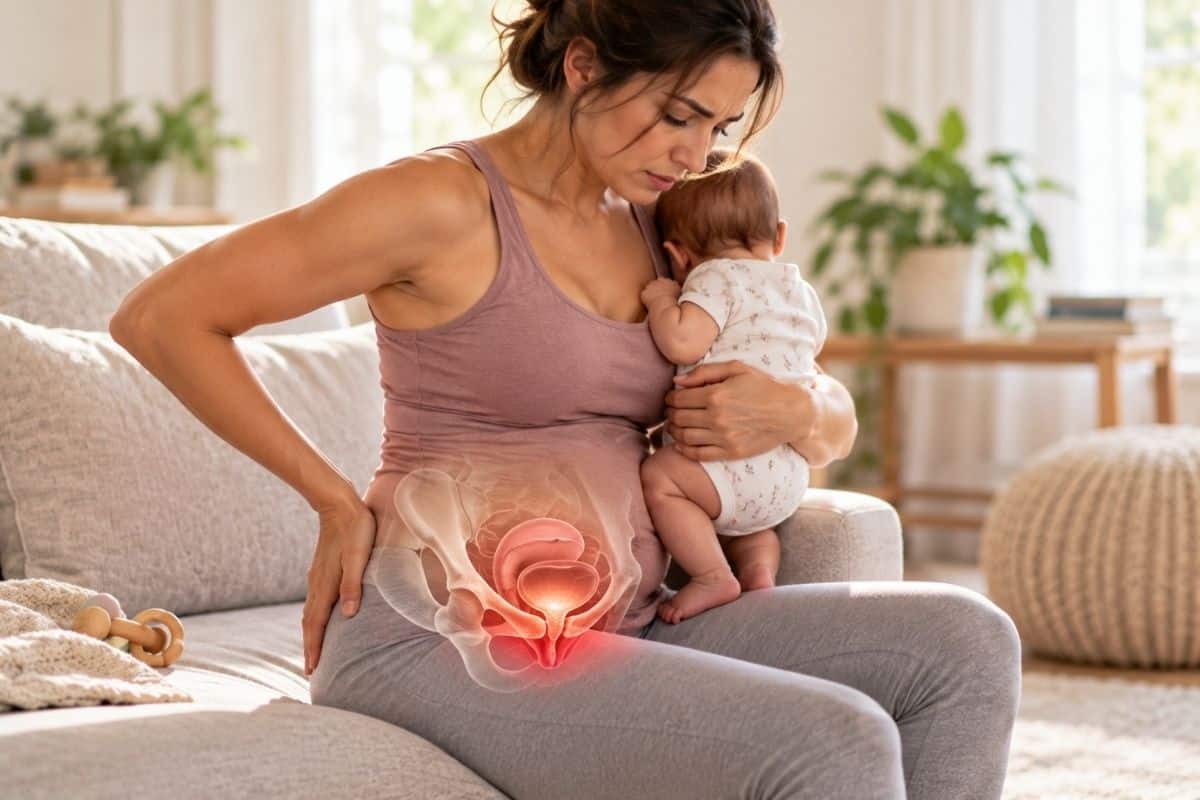
A tent stands because its fabric is stretched evenly across poles that hold tension in balance. Loosen the tension on one side, even slightly, and the whole structure sags in that direction, not because the fabric tore, but because the support underneath it can no longer hold the shape it used to. The pelvic floor works as that same kind of support structure, a sling of muscle holding the bladder, uterus, and rectum in place. After childbirth, many women feel a new, unfamiliar sensation of heaviness or downward pressure low in the pelvis, and this is the sling sagging, not failing outright.
Pelvic organ prolapse describes this sagging, and it is far more common after childbirth than most women are ever told to expect. Vaginal delivery stretches and sometimes tears the pelvic floor muscles and the connective tissue supporting them. Even a cesarean delivery, after nine months of a growing uterus placing downward pressure on this support sling, leaves the tissue changed. The heaviness a new mother feels, especially by the end of the day or after standing for long periods, is the tent losing its even tension, and it deserves a real conversation rather than the vague reassurance that this is simply what happens after having a baby.
The instinct many women have is to avoid movement altogether once they notice this heaviness, worried that any activity will make the sagging worse. This instinct is understandable but often works against recovery. A pelvic floor that never re-learns to generate tension will not regain its support capacity through rest alone, in the same way a slack tent line does not retighten itself just because nobody touches the tent. The tension has to be deliberately restored.
The First Area: Pelvic Floor Activation
The first area to address is pelvic floor activation, specifically whether a woman can produce a full, coordinated contraction and, just as important, a full release. Many women either cannot access the muscle at all after childbirth or unconsciously hold constant low-level tension that is exhausting and unhelpful. Both extremes need correcting before any loading work begins.
The Second Area: Intra-Abdominal Pressure Management
The second area is intra-abdominal pressure management, meaning how a woman breathes, lifts, and braces during daily tasks like carrying a car seat or bending to load a stroller. Poor pressure management sends force downward onto an already strained pelvic floor, worsening the sensation of heaviness even when the underlying prolapse is mild.
The Third Area: A Graded Return to Loaded Movement
The third area is a graded return to loaded movement, rebuilding the pelvic floor’s capacity gradually rather than either avoiding all activity or returning to full exercise intensity too soon. Both extremes tend to prolong the problem rather than resolve it.
Pelvic organ prolapse responds well to structured, guided pelvic floor rehabilitation, and the heaviness you may be feeling is not something you have to simply live with. Reach out to us to arrange a session with Denny, our specialist in the Reconnect Method, who works specifically with postpartum pelvic floor recovery.