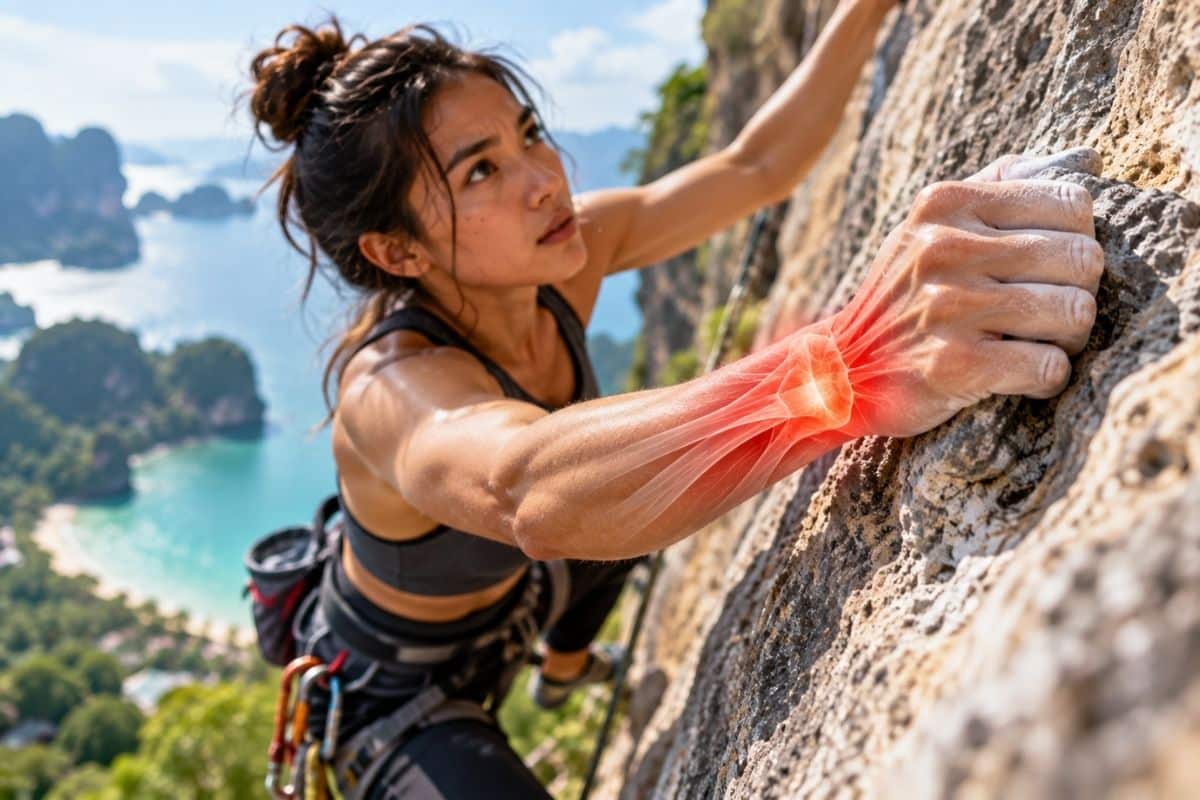
You climb regularly, whether indoors or on outdoor routes, and your forearm or wrist has started aching in certain grip positions. Small holds and crimping may be particularly uncomfortable.
You rest it, stretch your forearms and reduce your climbing for a while. The symptoms settle, but once you return to your previous intensity, the discomfort appears again.
Climbing places substantial demands on the fingers, wrists and forearms, but these areas do not work in isolation. The elbow, shoulder, shoulder blade and trunk all contribute to how your body manages force while you hold and move across the wall.
Why Wrist and Forearm Pain Is Not Always About Grip Strength
Grip strength matters in climbing, but stronger fingers are not the only requirement for managing difficult holds.
Your upper body needs to create a stable platform while your fingers maintain contact with the wall. The shoulder blade and muscles around the shoulder contribute to controlling your body against the pull of gravity.
If symptoms repeatedly develop during particular holds, it can therefore be useful to consider the entire upper-limb movement rather than focusing exclusively on the painful area.
Why Crimping Can Be Particularly Demanding
Crimp positions place substantial force through the fingers and the structures of the hand and forearm.
How much load those tissues experience depends on factors including hold size, grip position, climbing intensity, training volume and fatigue.
Increasing climbing volume or repeatedly using demanding grip positions faster than the tissues can adapt may contribute to irritation.
What Happens as Fatigue Builds?
Late in a climbing session, grip strength and upper-body control naturally begin to fatigue.
You may start gripping harder, spending longer on holds or changing the way you position your wrist, elbow or shoulder to remain on the wall.
Shoulder and scapular control can be relevant to this pattern, but recurring wrist or forearm pain does not automatically mean that an unstable shoulder blade is the underlying cause. Local tendon or joint irritation, technique, workload and recovery may also contribute.
Why Stretching the Forearm May Not Be Enough
Stretching can temporarily make an overworked forearm feel more comfortable, but recurring climbing pain may require more than improving flexibility.
Strength, load tolerance, climbing volume, grip selection and movement through the entire upper limb may all deserve attention.
At Abbysan, a Foundation Assessment can explore wrist and shoulder mobility, grip capacity and upper-body movement control to identify factors that may be relevant to your climbing.
Assess the Whole Chain
If wrist or forearm pain repeatedly returns when you reach the same climbing intensity, the pattern is worth investigating rather than simply repeating another cycle of rest and stretching.
Understanding how your hand, wrist, elbow and shoulder work together can provide a clearer direction for rebuilding the capacity your climbing requires.
Understand What Your Climbing Is Asking of Your Upper Body
Book a Foundation Assessment to explore your grip capacity, wrist and shoulder mobility, and movement control and identify factors that may be contributing to recurring discomfort while climbing.
