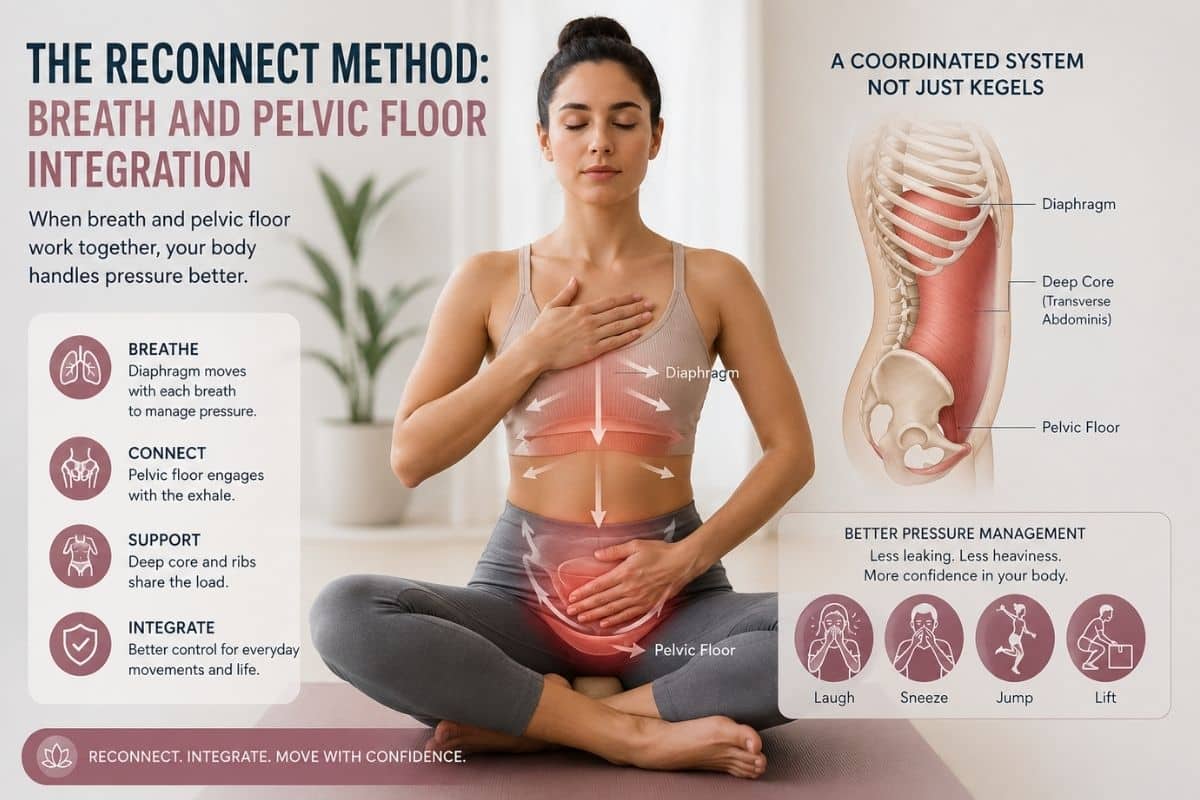
You leak a little when you laugh, sneeze, or jump. You have done the kegels, plenty of them, and it has not fully gone away. Or maybe there is no leaking at all, just a heaviness low in your body that never quite lifts.
You have been told to strengthen the pelvic floor. Nobody has asked what your breath is doing while you do it.
A weak pelvic floor is rarely the whole story. Where the pressure goes when you laugh, sneeze, or lift something matters just as much as how strong any one muscle is.
A sailboat does not hold its course by tightening one rope harder. The sail catches the wind, the ropes distribute the load, and the mast stays upright because all three are doing their share.
Your breath and pelvic floor work in a similar way. The diaphragm moves with every breath and helps manage pressure through the torso. When breathing becomes shallow or held, the pelvic floor can end up carrying more of that pressure than it should.
Why More Kegels Alone Do Not Fix the Leaking
Isolated pelvic floor exercises strengthen one part of the system, but real-life movement is rarely isolated.
A muscle may perform well during a controlled exercise while you are lying down and focusing on the movement. Then a sneeze arrives suddenly, and the body has to manage a fast pressure change without preparation.
If the breath, ribs, deep core and pelvic floor have not learned to respond together, strength alone may not be enough.
The Continence Foundation of Australia explains that the pelvic floor works with other core muscles and breathing mechanics to support continence and movement.
Strength without timing can still leave the system poorly coordinated.
What Integration Actually Means
Integration means the breath and pelvic floor respond together rather than acting like two separate instructions you have to remember.
As you exhale, the pelvic floor and deep core can coordinate to help manage pressure. The ribs and abdominal wall also share the load instead of sending all of that pressure downward.
Retraining this pattern is not simply about adding another exercise to a list. It is about restoring a sequence the body should be able to perform naturally.
This is the principle behind Abbysan’s pelvic floor therapy in Phuket, including The Reconnect Method led by Denny Jumpaon.
The Two-Stage Process, and What It Actually Takes
Restoring coordination usually happens in two stages.
First, the connection has to be found again. That means learning to feel the pelvic floor and breath working together, often before adding meaningful strength work.
Second, that connection has to remain available under load. Standing, lifting, laughing, sneezing, running and daily movement all challenge the system differently from lying calmly on a mat.
Skipping directly to harder exercise before the connection is established may lead to short-term improvement without lasting change.
Rebuilding awareness and coordination also takes time. For many people, consistent practice over several weeks or months is more realistic than expecting a rapid change in a few sessions.
Why This Is Not Only a Postpartum Issue
Pregnancy and birth are common reasons pelvic floor coordination can change, but they are not the only reasons.
Similar patterns can appear before conception, during painful periods, after surgery, with chronic straining, or in people who habitually hold their breath during effort.
Men can also develop pelvic floor coordination problems, especially when pressure management, breathing and core control become disconnected over time.
If strengthening has not solved the leaking or the heaviness has not lifted, the missing piece may not be more repetitions. It may be reconnecting the breath with the pelvic floor so the whole system shares the load.
Reconnect Breath and Pelvic Floor
Book a Reconnect Method session with Denny Jumpaon and learn how to restore coordination between your breath, pelvic floor and core during everyday movement.