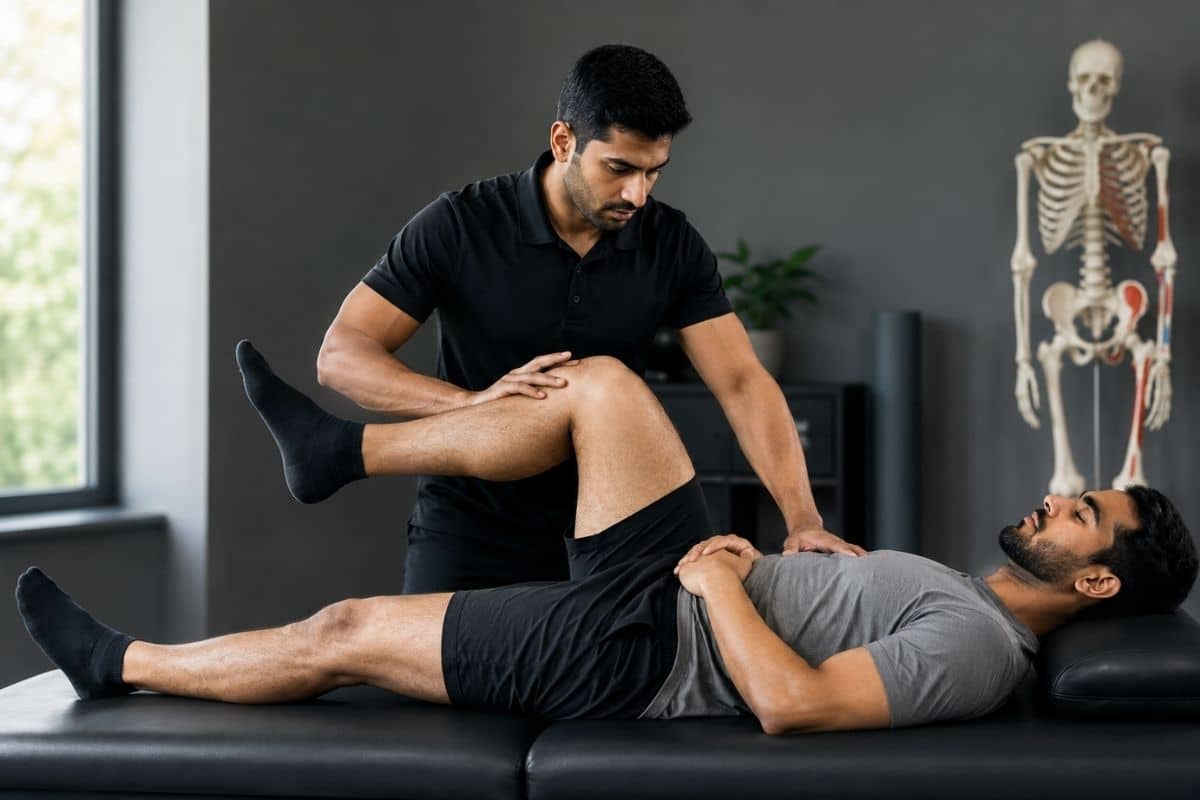
Physio and movement restoration are closely connected, but they are not always the same thing.
Physiotherapy can be extremely effective in helping people recover from injury, reduce pain, and improve physical function.
Many physiotherapists play a critical role in acute rehabilitation, post-surgical care, and pain management. However, despite treatment, some people still experience recurring pain, stiffness, or movement limitations months or even years later.
This often creates confusion.
If the pain improved temporarily, why did the problem return?
One possible explanation is that pain relief and complete movement restoration are not always the same thing.
Understanding the difference between physio and movement restoration is important for anyone dealing with chronic discomfort, recurring injuries, or long-term movement limitations.
1. Physio and Movement Restoration: Pain Relief vs Recovery
Pain reduction is often the first goal in rehabilitation.
When pain decreases, daily life becomes easier, movement feels safer, and the nervous system may become less reactive.
However, reducing pain does not automatically mean the body has restored efficient movement.
In some cases, symptoms improve while underlying movement limitations remain unchanged.
For example:
- a shoulder may stop hurting temporarily while poor thoracic mobility remains
- lower-back pain may reduce while hip movement restrictions continue
- knee discomfort may improve while foot and pelvic instability remain unaddressed
This is because pain is only one part of the problem.
The body may still be moving with:
- poor alignment
- inefficient load distribution
- compensation patterns
- weak joint control
When these factors remain unaddressed, irritation may return over time.
Pain relief is important. Nevertheless, long-term movement restoration also requires understanding how the body functions as a whole.
2. Acute Physio Care vs Chronic Movement Dysfunction
Acute injuries and chronic movement dysfunction are not always the same.
Acute conditions commonly involve:
- inflammation
- tissue irritation
- swelling
- recent trauma
- post-surgical recovery
Depending on the condition and clinical assessment, treatments may include:
- electrotherapy
- ultrasound
- TENS
- heat therapy
- manual therapy
These approaches may help manage symptoms and support appropriate stages of recovery.
However, chronic conditions are often more complex.
Many chronic problems develop gradually through:
- repetitive stress
- poor movement habits
- postural changes
- muscle imbalance
- compensation patterns
In these situations, pain may not result from a recent injury alone.
Instead, the body may repeatedly irritate certain tissues because movement mechanics and load distribution remain inefficient.
This may help explain why some people continue experiencing symptoms even when diagnostic scans do not fully explain their discomfort.
The issue may no longer involve tissue healing alone. It may also involve how the body organises movement under load.
3. Why Symptoms Can Return After Physio
One of the most frustrating experiences for many people is temporary relief followed by recurring symptoms.
This may happen when symptoms improve without fully changing the mechanical stress contributing to them.
For example:
- poor hip mobility may repeatedly increase lower-back loading
- reduced thoracic rotation may continue influencing shoulder mechanics
- foot instability may alter knee movement during walking or exercise
The pain may appear in one area, while contributing movement factors exist elsewhere in the body.
A systematic review available through PubMed examined movement-evoked pain assessment and rehabilitation interventions, highlighting the importance of evaluating symptoms in relation to movement rather than relying only on resting pain measurements.
If the body continues using the same compensation patterns, tissues may become irritated again after the initial symptoms improve.
This does not necessarily mean that physiotherapy or previous treatment failed.
Instead, it may mean that further assessment, rehabilitation progression, or movement retraining is required.
This is where physio and movement restoration must work together to improve how forces are distributed throughout the body.
4. Movement Restoration Treats the Body as a Connected System
The human body does not function as a collection of isolated parts.
Joints, muscles, fascia, breathing mechanics, posture, and the nervous system continuously influence one another.
A limitation in one area may create compensation elsewhere.
For example:
- reduced ankle mobility may influence the knee and hip
- pelvic instability may change spinal mechanics
- inefficient breathing patterns may contribute to neck and shoulder tension
This is why focusing only on the painful area may not always be enough.
The visible symptom is not necessarily the only contributing factor.
A broader movement assessment may include observing:
- posture and alignment
- joint control
- movement coordination
- load distribution
- compensation patterns
This process requires observation, appropriate assessment, and clinical reasoning.
The goal is not only to reduce pain but also to understand why the body repeatedly creates stress in the first place.
5. Movement Assessment and Kinesiotherapy
Movement assessment helps identify how the body organises itself during functional activities.
Rather than focusing only on symptoms, an assessment may examine:
- posture
- alignment
- movement efficiency
- joint stability
- muscular coordination
- compensation strategies
Once these factors are understood, exercise and movement progression can be selected more accurately.
This is where kinesiotherapy and movement-based rehabilitation may become valuable parts of a broader recovery plan.
Kinesiotherapy may focus on:
- strengthening underactive structures
- improving joint control
- restoring appropriate mobility
- retraining movement coordination
- improving load distribution
The goal is not simply to perform more exercises.
Instead, the goal is to help the body move more efficiently and tolerate appropriate loads without unnecessary irritation.
Developing this type of individualised approach requires careful observation and clinical decision-making. The Dr. Abhishek Mentorship programme explores clinical reasoning, movement assessment, and the process of selecting appropriate rehabilitation progressions.
At Abbysan, this is why assessment comes before progression.
Pain reduction matters, but restoring efficient and organised movement may help support longer-lasting improvement.
Final Thoughts on Physio and Movement Restoration
Physiotherapy can be highly effective, particularly during acute rehabilitation, post-surgical recovery, and pain management.
However, pain relief does not always mean that movement has been completely restored.
When posture, alignment, coordination, load tolerance, and movement mechanics remain limited, similar stress patterns may continue irritating tissues.
Long-term improvement may therefore require more than symptom reduction alone.
It may also require understanding how the body moves, how it distributes load, and how different systems interact during movement.
In many cases, the goal of physio and movement restoration is not simply to remove pain temporarily. The wider goal is to restore organised movement so the body can function more efficiently over time.