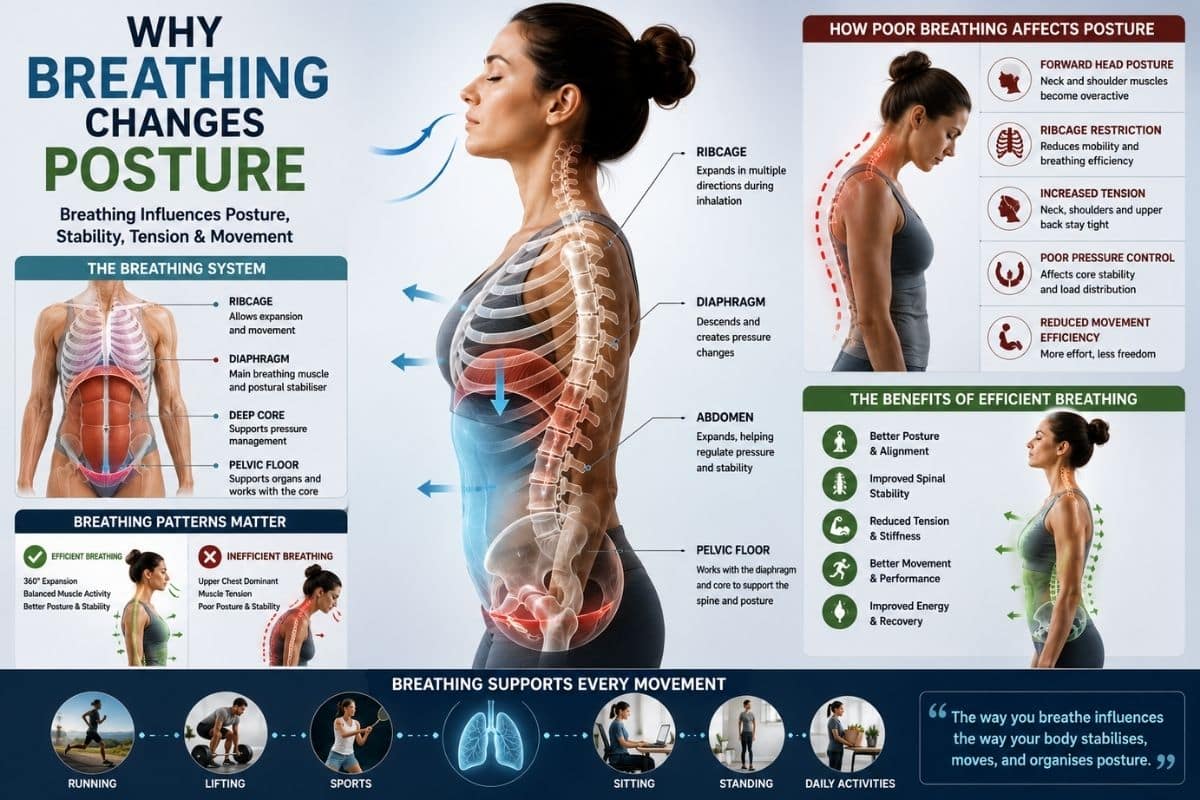
Most people think breathing is simply about oxygen.
However, breathing also plays a major role in posture, movement, spinal stability, and the way the body distributes tension under load.
Every breath creates movement throughout the body.
The ribcage expands, the diaphragm descends, pressure changes through the abdomen and pelvis, and the spine subtly responds to these shifts. This process happens automatically thousands of times each day without conscious awareness.
Because breathing and posture are closely connected, changes in breathing patterns can gradually influence how the body organises itself during movement and at rest.
Understanding this relationship helps explain why tension, stiffness, fatigue, and postural changes are often connected to the way a person breathes.
1. Breathing as a Movement Mechanism
Breathing is not only a respiratory process.
It is also a continuous movement mechanism.
Every healthy breath naturally creates expansion and motion through:
- the ribcage
- diaphragm
- abdomen
- spine
- pelvis
This movement helps regulate pressure throughout the trunk and allows the body to stabilise itself efficiently against gravity.
When breathing is functioning well:
- the ribcage expands naturally
- the diaphragm moves freely
- the spine remains more mobile
- muscles work with less unnecessary tension
A simple way to observe this is by taking a slow, deep breath.
Ideally, the ribcage should expand in multiple directions without excessive tension in the neck or shoulders.
If breathing feels restricted, shallow, or dominated by the upper chest, the body may already be compensating.
The quality of breathing often reflects the quality of movement organisation within the body.
2. The Relationship Between the Diaphragm and Posture
The diaphragm is one of the body’s primary breathing muscles, but it also plays a major role in postural control.
The diaphragm works together with:
- abdominal muscles
- pelvic floor
- deep spinal stabilisers
Together, these structures help regulate pressure and support the spine during movement.
This system is sometimes referred to as the body’s internal stabilisation mechanism.
Research published through PubMed on diaphragm contraction and postural stability found that the diaphragm becomes active during rapid voluntary limb movement, demonstrating its role in postural control as well as respiration.
When the diaphragm moves efficiently:
- pressure is distributed more evenly
- spinal support improves
- movement becomes more coordinated
However, when breathing becomes restricted:
- the ribcage may stiffen
- the neck and shoulders may become overactive
- spinal mobility may reduce
- posture may gradually change
Over time, this can contribute to:
- forward head posture
- ribcage restriction
- upper-body tension
- reduced movement efficiency
Therefore, the way a person breathes directly influences how the body organises stability and posture.
3. How Stress Changes Breathing Patterns
Breathing patterns are strongly influenced by stress, concentration, emotional tension, fatigue, and lifestyle habits.
Many people unconsciously change the way they breathe during:
- stressful situations
- computer work
- exercise
- overthinking
- lifting or physical effort
- pregnancy
In these situations, the body may become stuck in prolonged inhalation or exhalation patterns.
For example:
- some people constantly hold tension after inhaling
- others remain compressed in a partial exhalation state
Both patterns can increase stiffness and muscular tension over time.
A simple example is holding the breath after inhaling or exhaling completely.
Within seconds, most people begin to feel:
- increased tension
- stiffness
- reduced comfort
- pressure build-up
This demonstrates how closely breathing is connected to muscular tone and postural organisation.
These patterns often become so automatic that people no longer notice them.
4. Breath Holding, Stiffness, and Load Distribution
Unconscious breath holding is extremely common.
Many people briefly stop breathing during:
- exercise
- concentration
- lifting
- posture correction
- stressful conversations
- everyday tasks
While occasional breath holding is normal, habitual breath restriction can change how the body distributes load.
When breathing becomes restricted:
- muscles may remain excessively tense
- spinal movement becomes less fluid
- ribcage mobility decreases
- pressure distribution becomes inefficient
Over time, this may contribute to:
- neck and shoulder tension
- reduced mobility
- stiffness
- fatigue
- dizziness when standing quickly
- poor movement efficiency
Breathing influences not only oxygen intake but also how the body stabilises and transfers force during movement.
The body cannot move efficiently if it cannot regulate pressure efficiently.
5. Why Breathing Assessment Matters in Movement Therapy
Many movement problems are not purely muscular.
They may also involve breathing mechanics, pressure regulation, and postural control.
This is why breathing assessment is an important part of movement therapy and kinesiotherapy.
Assessment helps identify:
- ribcage restriction
- breathing asymmetry
- excessive neck breathing
- breath-holding habits
- poor diaphragm function
- inefficient pressure management
Once these patterns are understood, movement and breathing exercises can help restore more efficient mechanics.
The goal is not simply to “breathe deeper.”
Instead, the goal is to help the body:
- regulate tension more efficiently
- stabilise movement more naturally
- improve load distribution
- restore coordinated movement patterns
At Abbysan, breathing is assessed as part of posture and movement because the way a person breathes influences how the entire body organises itself under load.
The Movement Decision System can help identify how breathing mechanics, posture, stability, and movement patterns interact before an individual programme is selected.
Final Thoughts
Breathing affects far more than oxygen intake.
It influences posture, spinal mobility, muscular tension, movement efficiency, and the body’s ability to stabilise itself against gravity.
Because breathing occurs continuously throughout life, dysfunctional breathing patterns can gradually shape the way the body moves and holds tension.
The good news is that breathing is one of the few involuntary systems we can consciously influence.
By improving breathing mechanics, many people may experience improvements not only in posture and movement but also in energy, stability, and overall body awareness.
In simple terms, the way you breathe influences the way your body stabilises, moves, and organises posture.
