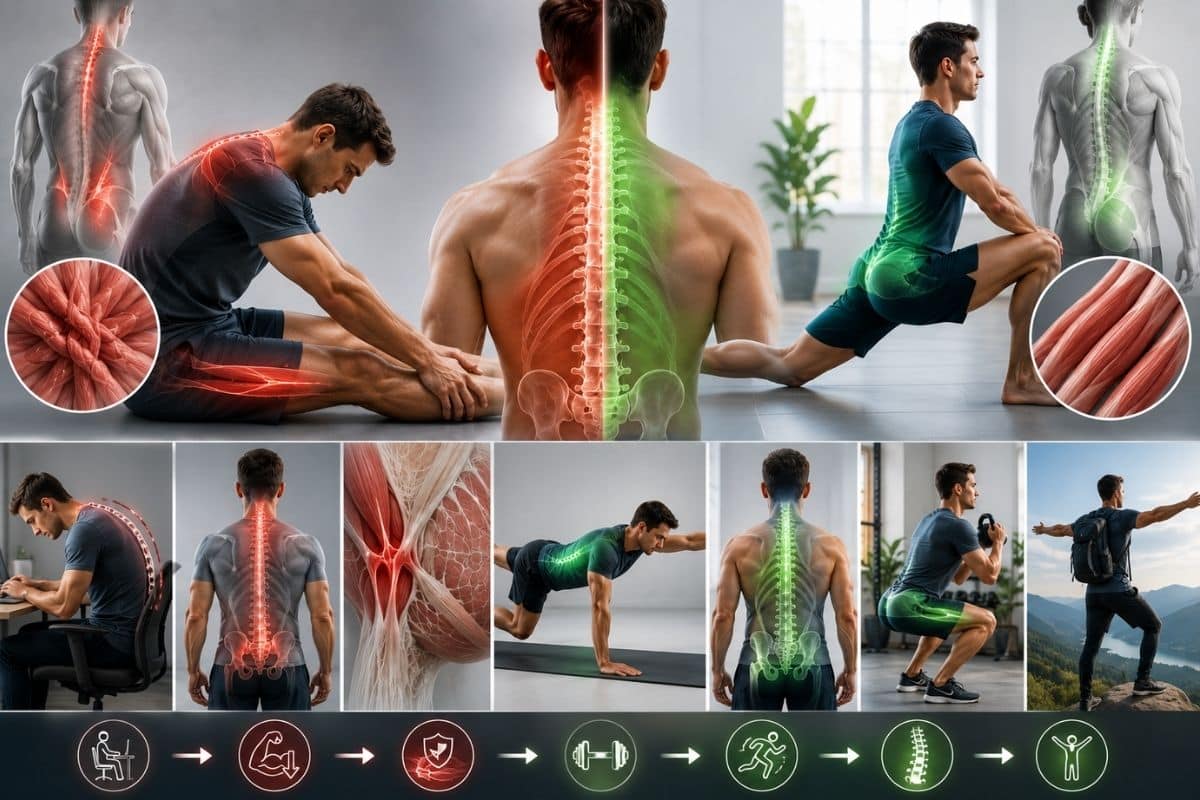
Many people assume that if a muscle feels tight, it must also be strong.
This is one of the most common misunderstandings in movement and rehabilitation.
In reality, weak muscles often become tight as well.
People frequently experience muscles that feel stiff, restricted, uncomfortable, or difficult to stretch, yet those same muscles may also be weak, poorly coordinated, and unable to stabilise joints effectively.
Understanding why this happens is important because stretching alone often does not solve the problem.
In many cases, the body first needs to restore strength, circulation, coordination, and movement efficiency before flexibility can improve properly.
1. Tightness Does Not Always Mean Strength
Muscles are responsible for much more than simply producing movement.
They help:
- stabilise joints
- absorb load
- maintain posture
- transfer force
- coordinate movement
A healthy muscle should be able to:
- contract efficiently
- lengthen efficiently
- tolerate load
- recover after activity
When a muscle loses these qualities, it may begin feeling tight even though it is not functioning well.
This is because tightness is often a protective response rather than a sign of strength.
The body frequently increases muscular tension around unstable or poorly controlled joints to create additional support.
As a result, muscles may feel:
- stiff
- restricted
- overworked
- difficult to relax
They may feel this way even while remaining weak and inefficient.
Therefore, the sensation of tightness does not always reflect functional strength.
2. Why Do Muscles Become Weak?
Muscles become weak for several reasons, but one of the most common is reduced or inefficient use.
This may happen because of:
- prolonged sitting or inactivity
- poor movement habits
- injury or trauma
- surgery
- nerve compression
- pain-related inhibition
- neurological conditions
- reduced movement variability
When muscles are not used effectively, they gradually lose:
- muscle mass
- tone
- endurance
- contractile efficiency
This process is known as muscular atrophy. According to the Cleveland Clinic’s overview of muscle atrophy, reduced muscle use can contribute to a loss of muscle tissue and strength.
Weak muscles often struggle to stabilise joints properly during movement.
As a result, surrounding tissues may begin compensating to maintain stability.
Over time, these compensations change movement mechanics and increase unnecessary tension throughout the body.
Weakness is therefore not only about reduced strength. It is also associated with reduced movement quality and lower load tolerance.
3. Protective Tension and Reduced Movement
The body constantly seeks stability.
When muscles become weak or movement becomes inefficient, the nervous system often responds by increasing protective tension around joints.
This tension limits excessive movement and creates temporary support.
However, maintaining this protective state continuously can reduce movement efficiency over time.
Muscles that remain tense for prolonged periods often move less and become less adaptable.
As movement decreases:
- joint mobility reduces
- circulation becomes less efficient
- tissue glide decreases
- stiffness increases
This is why people often feel:
- stiff after prolonged sitting
- tight after injury
- restricted after inactivity
The body is not necessarily creating strength. Instead, it is often creating protection.
The muscle may feel tight, but it may still be weak and poorly coordinated underneath that tension.
4. The Role of Fascia, Circulation, and Coordination
Muscles do not function in isolation.
They are surrounded and connected by fascia, a connective tissue network that helps distribute force and support movement throughout the body.
Healthy movement depends on:
- good circulation
- efficient tissue glide
- coordinated muscle activation
- balanced load distribution
When movement decreases and muscles remain tense or underused:
- circulation may reduce
- fascial tissues may become less mobile
- tissues may lose hydration and elasticity
- coordination between muscles may decline
This creates a cycle in which the body becomes less mobile, less efficient, and more protective.
As coordination decreases, the body often relies more heavily on dominant muscles while weaker stabilising muscles contribute less effectively.
Over time, this increases rigidity and movement imbalance.
5. Why Can Strength Improve Flexibility?
One of the most important concepts in movement therapy is that improving strength can often improve flexibility as well.
This is because functional muscles are not simply strong or flexible in isolation.
They are capable of:
- producing force
- controlling movement
- tolerating load
- lengthening when required
- recovering efficiently
When muscles regain appropriate strength and coordination:
- joint stability improves
- circulation improves
- movement becomes more efficient
- protective tension often reduces naturally
As the body becomes more confident and organised during movement, muscles no longer need to remain excessively guarded.
This often allows flexibility to improve more effectively than stretching alone.
At Abbysan, movement therapy and kinesiotherapy focus not only on increasing flexibility but also on restoring balanced movement throughout the body. A personalised Foundation Movement Assessment can help identify whether weakness, poor coordination, or compensation contributes to recurring muscle tightness.
The goal is not simply to create loose muscles.
Instead, the goal is to create functional muscles that can stabilise, lengthen, contract, and recover efficiently under load.
Final Thoughts
Tight muscles are not always strong muscles.
In many cases, weakness, poor coordination, reduced circulation, and protective tension exist together.
This is why stretching alone often provides only temporary relief.
Long-term improvement usually requires restoring strength, movement quality, and balanced load distribution throughout the body.
A functional muscle is not only strong. It must also be capable of moving efficiently, adapting to load, and recovering effectively.
