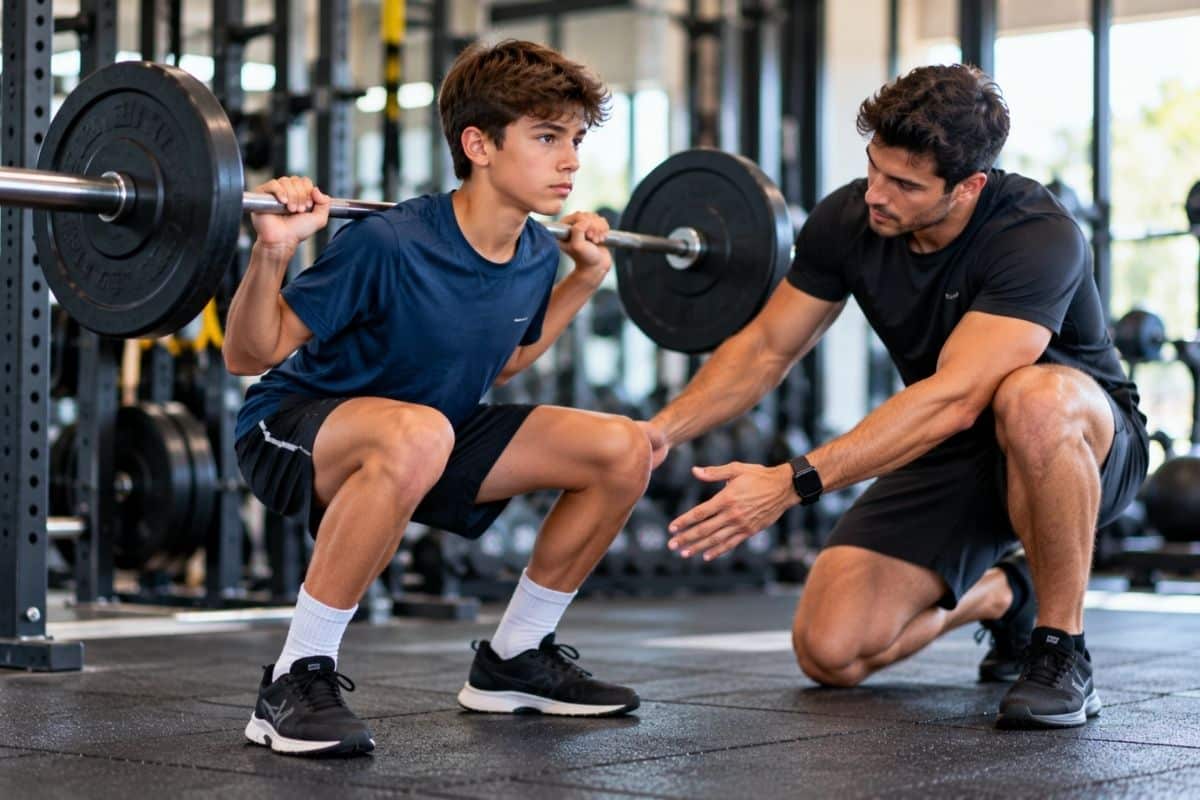
Think of your spine like a tent pole. If the ropes holding it are pulling unevenly from one side, the pole leans, and tightening the ropes further does not straighten a pole that is being pulled wrong to begin with. A young athlete’s skeleton has an additional complication a tent pole never faces: the pole itself is still under construction. Growth plates, the soft cartilage sections near the ends of long bones where growth actually happens, are considerably more vulnerable to repetitive stress than the surrounding mature bone, and a training program built for an adult’s fully formed skeleton can pull unevenly on a structure that has not finished forming.
Parents and coaches often worry about one dramatic injury, a fall, a bad landing, a collision. The more common problem in youth strength training is quieter: repetitive overload at a growth plate from a training volume, an exercise selection, or a technique error that would be entirely manageable for an adult but places a young athlete’s still-developing bone under more repeated stress than it can currently handle. This shows up as a nagging, activity-related ache at a specific joint, often the knee, hip, elbow, or shoulder, that improves with rest and returns as soon as training resumes, a pattern many families and coaches misread as ordinary growing pains rather than a genuine overuse injury at a vulnerable growth site.
The tent pole framing matters here because the solution is not to avoid strength training altogether, any more than the answer to an unevenly pulled tent pole is to remove all the ropes. Structured strength training benefits young athletes considerably, when the loading is matched to what their specific stage of skeletal development can currently tolerate.
The First Area: Training Volume and Exercise Selection
The first area to assess is training volume and exercise selection relative to the athlete’s specific sport and growth stage, since a young athlete specializing early in one repetitive movement pattern, one throwing motion, one running gait, one jumping pattern, concentrates stress at the same vulnerable point far more than a young athlete exposed to varied movement.
The Second Area: Technique Quality Under Fatigue
The second area is technique quality under fatigue specifically, since growth-plate injuries in young athletes often develop late in a session or late in a season, when form breaks down and compensations place unusual stress on a joint that would otherwise be adequately protected by clean mechanics.
The Third Area: Recognizing Early Warning Signs
The third area is recognizing early warning signs, a specific ache that reliably appears with a specific activity and reliably eases with rest, and taking that pattern seriously rather than assuming it will resolve on its own as the athlete gets older.
For additional information about safe strength training for children and teenagers, the American Academy of Pediatrics’ guidance on strength training explains the importance of proper technique, appropriate supervision, and age-appropriate exercise programs.
Strength training and youth sport can coexist safely when the loading respects a still-developing skeleton. Come see us for a movement assessment so we can help build a training approach that grows with your young athlete rather than against them.
Young athletes need strength training that supports their developing bodies. A Foundation Assessment can help identify movement limitations, technique concerns, and training demands to guide a safer, more effective approach to strength and performance.