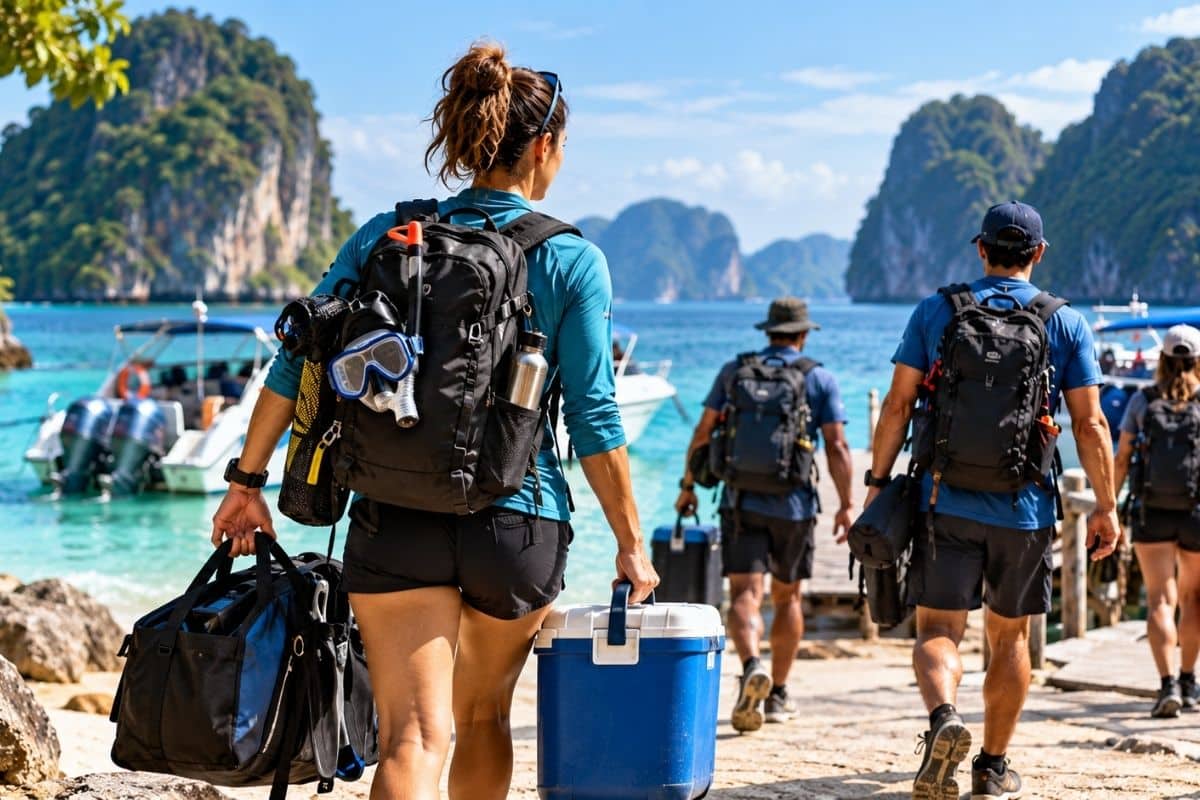
Think of a joint like a cogwheel, meant to turn smoothly through every angle because the fluid and tissue around it move the way oil moves inside a cogwheel. Tour guides and activity staff spend full days carrying bags, water coolers, snorkeling gear, and first aid kits, usually slung over the same shoulder out of habit, while also walking long distances over uneven ground, boat decks, and boarding ramps. This combination, sustained one-sided carrying plus constant walking on unpredictable surfaces, wears down the shoulder and hip cogwheels differently than almost any other job in Phuket’s tourism industry.
A bag carried consistently on one shoulder pulls that shoulder down and slightly forward for hours at a time, compressing the same small space inside the joint where tendons need to glide smoothly with every arm movement. Repeated day after day across a long tourism season, that compression can gradually thicken the tissue in that space, exactly the mechanism behind a joint losing its full, smooth range of motion. The cogwheel does not seize all at once. It starts catching gradually, at first only noticeable when reaching overhead or reaching behind the back, then increasingly present during ordinary daily movement.
The walking component adds its own demand. Uneven ground, boat decks, and boarding ramps require constant small adjustments through the hips and ankles to maintain balance, a demand that accumulates across a full day of guiding, on top of the shoulder load from the bag itself. Guides frequently describe this combination as a whole-body tiredness that feels different from a job that is purely walking or purely carrying, because it genuinely is a different, compounded demand.
Assessing Shoulder Rotation and Range of Motion
The first area to address is shoulder rotation and range specifically, checking for early signs of restriction in the same shoulder that consistently carries gear, since catching this early prevents the kind of gradual, deep restriction that becomes much harder to resolve once fully established.
Alternating Shoulder Loads to Reduce Repetitive Strain
The second area is deliberately alternating which shoulder carries the bag and gear throughout the day, distributing the load rather than defaulting to the same side purely out of habit, which spreads the compressive demand rather than concentrating it in one joint.
Improving Hip and Ankle Stability on Uneven Terrain
The third area is hip and ankle stability for uneven terrain, building the specific balance capability that walking on sand, boat decks, and boarding ramps demands, since this differs meaningfully from the stability needed on a flat, predictable surface.
For additional information on reducing workplace physical strain, the National Institute for Occupational Safety and Health (NIOSH) provides resources on ergonomics, musculoskeletal health, and occupational injury prevention.
A job spent guiding others through Phuket’s islands and trails deserves a body prepared for the specific demands that role actually places on it. Come see us for a movement assessment so we can help protect your shoulders and hips through a long season of guiding.
Carrying equipment and navigating uneven terrain throughout the day can place repeated demands on your shoulders, hips, and ankles. A Foundation Assessment can help identify movement restrictions, muscle imbalances, and stability limitations to support safer, more comfortable movement during Phuket’s busy tourism season.