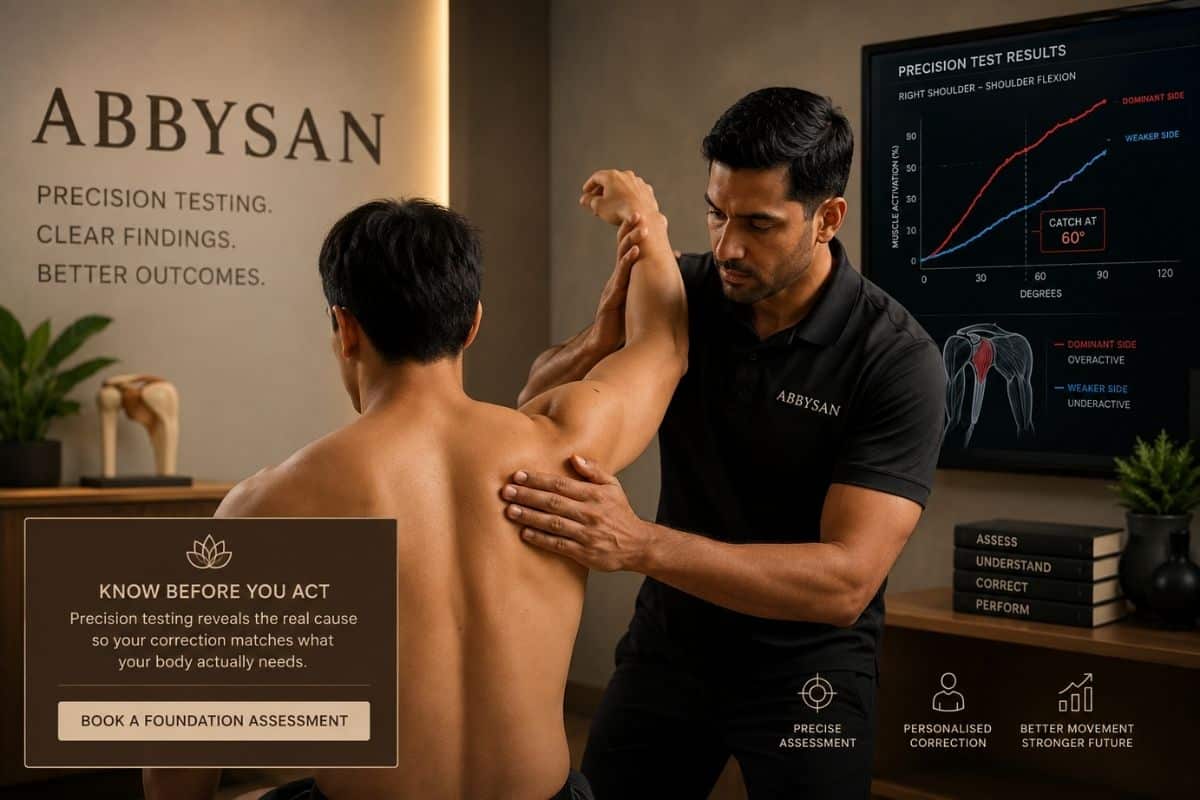
Your shoulder catches on the way up, in the same spot, every time. Your knee grinds going down stairs, but not going up them. You have been told it is wear and tear or that you simply need to get stronger. So you strengthen it. The catch is still there.
That catch does not always mean that damage has occurred. In some cases, muscles around the joint may pull or stabilise unevenly, allowing one side to dominate the movement.
Muscles and joints work like a rope and pulley. When the muscle on one side weakens, the opposite side may begin pulling harder. The joint shifts slightly, and each time it moves through that point, both sides compete for control. That struggle may contribute to the catch you feel.
Why Does More Strength Not Fix It?
Generic strengthening often loads whichever side already performs most of the work because that is the side you naturally feel and use.
As a result, the dominant side becomes stronger while the quieter side remains inactive. The pulley stays uneven, but now it operates with even more force behind it.
This helps explain why some people leave the gym with a catch that feels sharper than before. Nothing necessarily tore during the session. Instead, the existing imbalance may have become more noticeable.
The rotator cuff, for example, helps raise and rotate the arm while stabilising the head of the upper-arm bone within the shoulder joint. The American Academy of Orthopaedic Surgeons explains how the rotator cuff supports shoulder movement and stability.
What Is Precision Testing Actually Measuring?
Precision testing is not about how much weight you can lift. Instead, it identifies which side of a joint performs work that another muscle should share.
Which muscle activates first when you raise your arm? Which side of the hip accepts the load when you step down? At what exact point does the catch appear, and what happens on each side of the joint at that moment?
Those answers relate specifically to your joint rather than joints in general. A catch at forty degrees of shoulder flexion may indicate a different movement pattern from a catch at ninety degrees.
Treating both patterns in exactly the same way can cause someone to strengthen the side that was already dominating the movement.
At Abbysan, the Foundation Assessment uses a personalised, assessment-led approach to examine posture, movement, loading patterns and the way different parts of the body work together.
Why Does the Correction Have to Match the Finding?
Once precision testing identifies the side that has become less active, the correction follows a clear order: activate and retrain that side before asking the dominant side to perform more work.
Skipping that order allows the stronger side to continue taking control. The catch may then keep returning, regardless of how much general strengthening you complete around it.
This principle guides every Foundation Assessment at Abbysan. First, identify the imbalance. Then, choose the correction according to what the assessment actually reveals rather than relying on what commonly works for someone else’s shoulder or knee.
If something in your body catches, grinds or hesitates at the same point every time, it may not need more generic strengthening. It may need careful testing to understand how the joint and surrounding muscles share the load.
Find Out Which Side Has Gone Quiet
Book a Foundation Assessment to identify the movement imbalance behind the recurring catch, grind or hesitation and receive a correction matched to your findings.