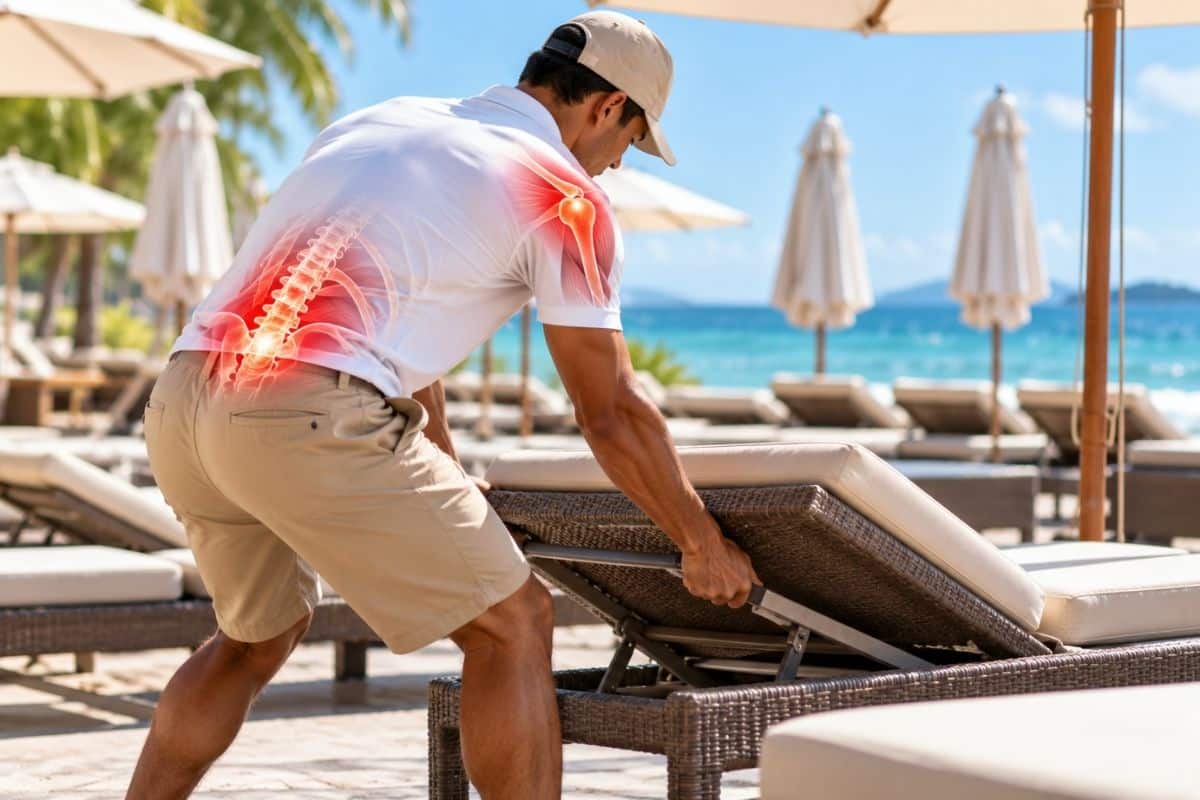
A sailboat crossing calm water barely strains its rigging, but the same boat crossing choppy water hour after hour eventually wears through a line at exactly the point where the tension concentrates. The rope does not fray randomly along its length. It frays at the one point where the same stress repeats every single time. Poolside and beach club staff who set up loungers, drag umbrellas, and reposition heavy furniture dozens of times a shift develop pain in a strikingly consistent location for the same reason. It is not bad luck. It is the same point on the line taking the same load, shift after shift.
Setting up a sunbed looks like light work from the outside, but the actual mechanics involve a forward bend, a rotation, and a pull, often repeated with a slight variation in stance every time depending on how the previous guest left the furniture. This combination of bending, twisting, and pulling under load is one of the most predictable ways to overload the lower back and shoulder, particularly when the same side of the body does the reaching and pulling because of how a staff member naturally favors one arm.
The point of highest tension in this repeated motion is usually the lower back at the point of rotation, or the shoulder on the pulling side at the point where the arm is furthest from the body. Just as a sailboat’s rigging fails at the point of greatest mechanical disadvantage rather than evenly across the whole line, the body breaks down at the joint working hardest at the worst angle, not at the muscle doing the most obvious labor.
The First Area: Bending and Lifting Pattern
The first area to address is the bending and lifting pattern itself, specifically whether a staff member is hinging from the hips with a braced core or rounding through the lower back to reach the furniture. This single mechanical difference determines whether the lower back absorbs repeated strain or shares the load properly with the hips and legs.
The Second Area: Alternating Sides Deliberately
The second area is alternating sides deliberately. Most staff default to using their dominant side for every pull and drag without thinking about it, which concentrates the same wear pattern shift after shift. Deliberately alternating which side leads the motion distributes the load rather than letting one shoulder and one side of the lower back absorb it disproportionately.
The Third Area: Shoulder and Rotator Cuff Endurance
The third area is shoulder and rotator cuff endurance, since repeated pulling motions at shoulder height or below without adequate strength in the muscles that stabilize the shoulder blade lead to the fraying, catching sensation many staff describe by the end of a long season. Building this endurance specifically for the pulling pattern used on the job protects against the exact wear the role creates.
Work that looks easy from a distance can still wear down a body in very specific, predictable places, and understanding those places is the first step toward protecting them. Come see us for a movement assessment so we can identify your specific wear points before they become an injury.